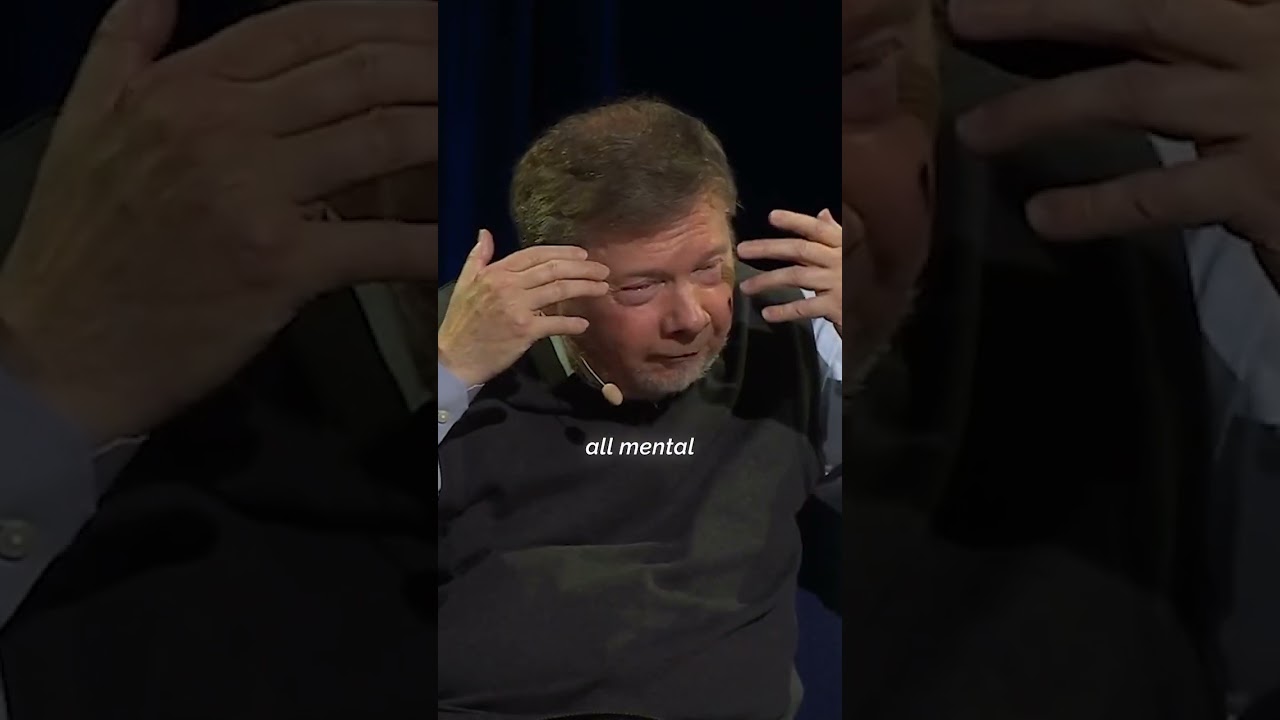
Eckhart Tolle investigates the fundamental question of human identity, examining whether the self is constructed from thoughts, possessions, achievements, and social roles—or whether a deeper, unchanging essence exists beneath these temporary identifications. He challenges the common assumption that we are our thoughts and possessions, suggesting instead that the capacity to observe these phenomena points to a witnessing consciousness that transcends the content of the mind and the material forms we accumulate.
What is identity, and where does it come from?
Most people assume their identity is synonymous with their personality, accomplishments, and the things they own. We say "I am a lawyer," "I am a parent," "I am successful," or "I am the sum of my experiences." This identification runs so deep that we rarely question it. Tolle's inquiry begins with a simple but radical observation: if your identity is truly your thoughts, then who is observing those thoughts? If you are your possessions, what happens to your identity when those possessions change or are lost?
This questioning is not academic. For most people, identity is built on an unstable foundation. Our thoughts change constantly—we have thousands of them daily, many contradictory. Our possessions are temporary. Our roles shift with circumstance. Our bodies age and transform. If any of these is the true self, then the true self must be in constant flux, continuously unstable, always under threat of dissolution.
Yet there is something in us that remains constant: the awareness that observes all these changes. This is the core of Tolle's teaching on identity. The real question is not "What am I?" but rather "Who is aware of what I think I am?"
Are you your thoughts?
The assumption that we are our thoughts is so fundamental to modern consciousness that most people never examine it. We experience a stream of mental activity and naturally conclude, "This is me thinking." But Tolle invites a direct observation: Can you watch your thoughts? If you can observe a thought, can you be the thought? The thing that observes is different from the thing observed.
This distinction is crucial. When you become aware of your thoughts—when you notice that you're worried, planning, or ruminating—you have already stepped outside the thoughts themselves. A part of you has separated from the mental content and is observing it. This is the capacity of consciousness itself, independent of thought. It is the awareness that makes thought visible, the silent witness that requires no thought of its own to exist.
In daily life, most people are completely identified with their thoughts. They experience their thoughts as themselves, which means they are not free. They are prisoners of the mental content that is constantly being generated. When an anxious thought arises, the identified person is that anxiety. When a judgmental thought arises, the identified person is that judgment. There is no space between awareness and the content of awareness.
The liberation begins when this identification weakens. When you can observe a thought without immediately becoming that thought, you have accessed something deeper than the thinking mind. This is not suppression or denial of thought; it is a shift in identification away from the mental content toward the awareness itself.
Can possessions define the self?
Identity through possessions is equally fragile. Many people derive a sense of self from what they own: a house, a car, clothes, status symbols. There is an implicit belief that "I am valuable because I own valuable things" or "I am secure because I possess these objects." The problem is that objects are subject to impermanence. They can be lost, stolen, destroyed, or become outdated. The person who identifies with possessions has tied their sense of self to things that are inherently unstable.
Moreover, possessions are external to the body and consciousness. They are things that happen to be in your possession temporarily. They are not intrinsic to who you are. This can be tested through thought experiment: if you lost your possessions tomorrow, would you cease to exist? Would you be a different person? Most would agree that while the loss would be painful and disruptive, the core of who you are would remain. This reveals that your true identity is not lodged in these external objects.
The same applies to status, credentials, and achievements. These are things you have accomplished or acquired, but they are not what you fundamentally are. A person who loses their job, their title, or their status experiences a crisis of identity because they had mistakenly believed their identity was their role or achievement. When the role changes, the identified self collapses. This is why retirement, job loss, and status shifts are often psychologically devastating for those who have fused their identity with external circumstances.
What remains when all identifications are removed?
If you are not your thoughts, not your possessions, not your roles, not your body (which is constantly changing at a cellular level), then what are you? This is the essential inquiry. Tolle points toward the answer through direct experience: you are the awareness, the consciousness, the presence that observes all of this. You are the space in which thoughts arise. You are the silent witness that does not depend on any of these identifications to exist.
This witnessing consciousness is often called "presence" or "being" in spiritual traditions. It is not something you have to create or attain. You already have access to it right now, in this moment. It is the fact that you are aware. It is the light by which you see everything else. You cannot see the light by looking at what it illuminates; you can only know it through the knowing itself.
This essential self is not personal in the way we normally think of personality. It does not have a biography, a set of opinions, or a collection of memories. Memories arise in consciousness, but consciousness itself is not a memory. The sense of "I am" that precedes all thoughts and identifications—that simple, irreducible awareness of existence—this is closer to the true self. It is untouched by time, by achievement, by loss, by circumstance.
Why do people resist letting go of identifications?
If the true self is so much deeper and more stable than the constructed identity, why do people cling so fiercely to their thoughts, possessions, and roles? The answer involves fear and habit. The ego—the psychological self that is built on identifications—experiences any loosening of these identifications as a threat to its existence. It feels like death because the ego, in a real sense, is dying when you stop being defined by its content.
There is also a practical concern. Identifications give a sense of continuity and coherence to life. Without them, the person fears they will become directionless, irresponsible, or "nobody." The ego convinces us that we need our identifications in order to function. This is only partially true. While identifications may create a sense of direction, the deepest sense of direction comes from being aligned with presence and purpose, not from clinging to the ego's self-image.
Moreover, there is tremendous social reinforcement of identity through identification. Other people relate to you based on the persona you present. Your name, your role, your history—these are all part of the social contract. Stepping outside these identifications can feel socially dangerous, even though the core of your being would remain unchanged.
What changes when you shift identification to presence?
When someone begins to identify less with their thoughts and possessions and more with the witnessing consciousness beneath them, several things shift. First, there is a sense of spaciousness. Thoughts are no longer claustrophobic. They arise and pass without compulsively defining who you are. Emotions become something you experience rather than something you are. You can feel anger without believing "I am an angry person."
Second, there is a reduction in psychological suffering. Much of our suffering comes not from circumstances themselves but from the stories we tell about those circumstances. An identity-based mind is constantly reinforcing stories about itself: "I'm not good enough," "I'm unlucky," "I'm responsible for everyone's happiness." When identification loosens, these stories lose their power. Circumstances may still be challenging, but they are not immediately interpreted through the lens of personal identity, so there is more freedom in how to respond.
Third, there is a paradoxical sense of wholeness. When you stop trying to construct and defend an identity, you discover that you are already whole. You don't need to become someone else or acquire more things to be complete. This is not complacency; it is a foundation from which genuine growth and engagement with life can arise, but without the anxiety and desperation that usually drives human striving.
Where to go from here
The inquiry into identity is not meant to be merely intellectual. It invites direct observation. Notice throughout your day: To what am I attached as identity? When I feel upset, what story am I telling about who I am? Can I observe my thoughts without being consumed by them? What remains when I stop thinking about myself for even a moment?
These are not rhetorical questions. They are invitations to a direct, lived understanding of who you are beyond your identifications. This understanding does not require belief in any spiritual doctrine. It requires only honest attention to your own experience. As you practice this observation, the constructed identity naturally loosens its grip, not through force but through the clarity that comes from seeing directly what is real and what is temporary illusion.