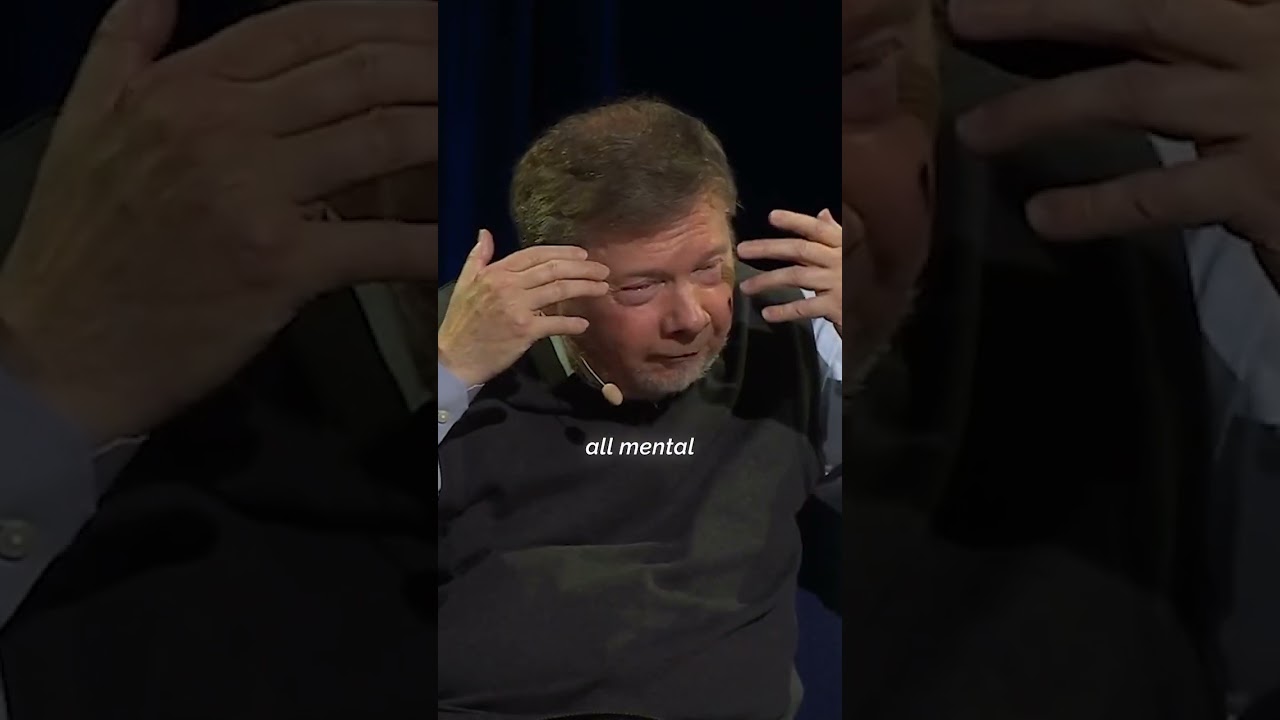
Eckhart Tolle presents a radical reframing of human identity: rather than understanding yourself as a separate individual self searching for meaning in an external world, you are fundamentally a localized expression of universal consciousness inhabiting a temporary human form. This shift dissolves the existential anxiety rooted in separation and reveals consciousness itself as your primary nature. The implication is not mystical escapism but a practical reorganization of how you relate to thought, suffering, and your place in existence.
What Does It Mean to Be a Ray of Universal Consciousness?
The statement "you are a ray of universal consciousness" inverts the conventional self-narrative. Most people operate from the assumption that they are a bounded, individual self—a distinct "I" located behind the eyes, containing thoughts and feelings, trying to navigate a world that is fundamentally other. This separate self seeks meaning, accumulates experiences, and tries to secure its future against an uncertain universe.
Tolle's teaching suggests this framework is backwards. Consciousness is not produced by the brain or contained within an individual mind. Rather, consciousness is the fundamental substrate of existence, and what you call your "self" is a temporary, localized expression of that universal field of awareness. The individual "I" is like a wave on the ocean—a distinct form, but inseparable from the water itself. Your thoughts, perceptions, and sense of identity arise within consciousness, but are not the source of consciousness.
This reframing has immediate consequences. If you are fundamentally consciousness rather than a separate ego seeking security, the entire engine driving modern anxiety shifts. You are not trying to make yourself real or meaningful through accomplishment, accumulation, or identity construction. You already are—not as a separated self, but as an expression of existence itself.
Why Is the Sense of Separation an Illusion?
The belief in a completely separate self is less an observation than a habit of mind. When you identify exclusively with the stream of thoughts passing through awareness, you create a sense of being trapped inside your own head, forever separate from the world and other people. This psychological isolation is deeply stressful.
Tolle teaches that this separation is not perceptual reality but a constructed identity. The boundary between "me" and "not-me" is real as a functional distinction, but the absolute division—the sense that consciousness is contained only within your skull and that everything outside is foreign—is a misinterpretation of experience. In direct, moment-to-moment awareness, you are not actually isolated. Consciousness is continuous; perception, sensation, and awareness have no inside-outside boundary in their fundamental nature.
This is not a matter of belief but of noticing what is actually happening. When you see a tree, the visual experience of the tree is not inside your brain; it is present in consciousness. When you hear a sound, the sound itself is present in awareness. The very fabric of your experience reveals that consciousness and the world are not separate. The feeling of separation comes from identified thought, not from actual experience.
How Does This Shift Change Your Relationship to Identity?
Most people derive identity from roles, relationships, achievements, and history. "I am a professional, a parent, someone with anxiety, a person who was hurt." These identities feel real and protective—they explain who you are and justify your responses. But they are also rigid and isolating.
If you recognize yourself as a ray of universal consciousness, identity becomes much more fluid. The human form you are temporarily inhabiting has certain capacities, conditioning, and history, but that is not fundamentally who you are. You are the awareness in which all of that appears. From this vantage point, negative self-concepts lose their grip. You are not essentially broken, inadequate, or separate. You are consciousness itself, temporarily focusing through the lens of a particular human life.
This does not mean denying the human dimension or becoming detached from life. Rather, it means relating to your humanity—your thoughts, emotions, and experiences—from the freedom of consciousness rather than from the imprisonment of thought-based identity. Practical life continues, but without the existential desperation that arises when the ego believes it must manufacture its own existence.
What Is the Difference Between Individual Consciousness and Universal Consciousness?
This teaching does not deny individual perspective. You have unique sensory apparatus, conditioning, and point of view. The particular stream of experience flowing through this human form is distinct from the stream flowing through another. But the awareness in which these experiences arise is the same. There is not a separate "universal consciousness" floating in the sky and a separate "my consciousness" inside my head. There is one consciousness, temporarily and locally experiencing itself through billions of forms.
The metaphor of the ray is apt: a ray of sunlight appears distinct from the sun while it is traveling through space, but it is the sun. There is no ray-light and sun-light as separate substances. Similarly, your individual consciousness and universal consciousness are not two things. Your individual perspective is how universal consciousness is experiencing itself right now through your particular form and circumstances.
This explains why the teaching has such integrative power. You do not have to dissolve individuality or abandon your life to realize your true nature. The individual continues functioning, but it is no longer running on the fuel of existential fear. It is animated by the freedom and aliveness of consciousness itself.
How Does Wearing a Human Form Work if You Are Consciousness?
The phrasing "temporarily wearing a human form" acknowledges a key paradox: the teaching is not anti-body or anti-life. Consciousness is not disembodied and floating above existence. Rather, consciousness is expressing itself fully through matter, through biological forms, through the entire physical dimension. You are not trapped in a body; you are consciousness taking bodily form.
This temporary nature is significant. The body will age and die. The particular personal history associated with this form will end. But the consciousness that was animating it does not end—it is not owned by the form in the first place. Recognizing this while alive transforms your relationship to mortality. You are not trying to make your personal self immortal; you already are the eternal principle of awareness. What is temporary is the form and the personal identification, not consciousness itself.
This is not meant to diminish human experience. On the contrary, it liberates you to inhabit your form and life more fully. When you are no longer running from the thought "I am going to die," you are available to the aliveness of being alive. When you are not defending a constructed self, you can respond authentically to others and to life. The temporary human form becomes a vehicle for consciousness to know itself rather than a prison the separate self must escape.
What Changes When You Stop Searching for Meaning Outside Yourself?
Much of human suffering flows from the project of finding meaning. You are supposed to figure out what your life is for, what gives it value, what makes you significant. This search is exhausting because it treats meaning as something external—a purpose to be discovered, a role to fill, an achievement to attain. If you don't find it, you feel your life is empty.
Tolle's teaching suggests this entire search is misoriented. You do not need to find meaning because you are already meaningful. Consciousness is not a void that needs to be filled with purpose. It is fullness itself, presence itself. When you recognize yourself as this consciousness, meaning stops being something you need to hunt for and becomes something you notice in simply being alive.
This does not make life passive or aimless. In fact, without the desperation of ego seeking validation, actions become clearer and more aligned with what is actually needed in each moment. You do not do things to prove yourself or to secure identity. You respond to life. Work, relationships, creativity, and contribution all happen, but they flow from aliveness rather than from psychological need. The quality of life often deepens because you are no longer filtered through constant self-referential thinking.
How Does This Relate to Everyday Experience?
These are not abstract principles. Tolle's teaching invites direct investigation of your own experience. Right now, where is consciousness? You might say it is in your head, but if you look closely, awareness includes the room you are sitting in, the sounds you hear, the sensations in your body. Consciousness is not located in a single point; it is the space in which all of this is appearing. The mind that tries to locate itself is like an eye trying to see itself without a mirror.
The teaching also addresses the practical matter of suffering. You suffer primarily through identification with thought. A thought arises: "I am not good enough." If consciousness identifies with this thought, taking it as true about the self, suffering follows. But if you notice that the thought is arising in consciousness, that you are aware of it, then you are not the thought. You are the awareness in which the thought appears. This simple noticing begins to dissolve identification.
Similarly, when pain or difficulty arises in life, the habitual response is to generate a story about it: "This shouldn't be happening. This proves something is wrong with me. This means my future is threatened." These stories create suffering on top of the actual situation. When consciousness is recognized as your primary nature, the compulsion to defend the ego through these stories weakens. You can be present to difficulty without adding the psychological layer of resistance.
Where to Go From Here
This teaching is not meant to remain theoretical. The shift from understanding yourself as a separate self to recognizing yourself as a localized expression of universal consciousness is available in direct experience, not just in intellectual understanding. It begins with simple noticing: pausing your identification with thought and asking "What is aware of this?" Meditation, contemplative practice, and the investigation of your own nature are all means of deepening this recognition.
The teaching also has implications for how you engage with modern life. If you are consciousness, not a separate ego, then your fundamental security does not depend on controlling outcomes or amassing resources. This does not mean becoming irresponsible, but it does mean you can make decisions and take action without the psychological desperation that comes from believing your existence is at stake. Relationships shift when both people are relating as consciousness rather than as defended selves. Creativity flows more freely when the pressure to prove yourself is lifted. Even practical daily life becomes simpler when you are not constantly managing identity.
Tolle's teaching invites an ongoing investigation rather than a belief system to adopt. The question becomes: What happens when I stop taking my thoughts as definitions of who I am? What is actually here when I am not lost in the story of self? What does direct, unfiltered consciousness feel like? These are not rhetorical questions but invitations to your own discovery.