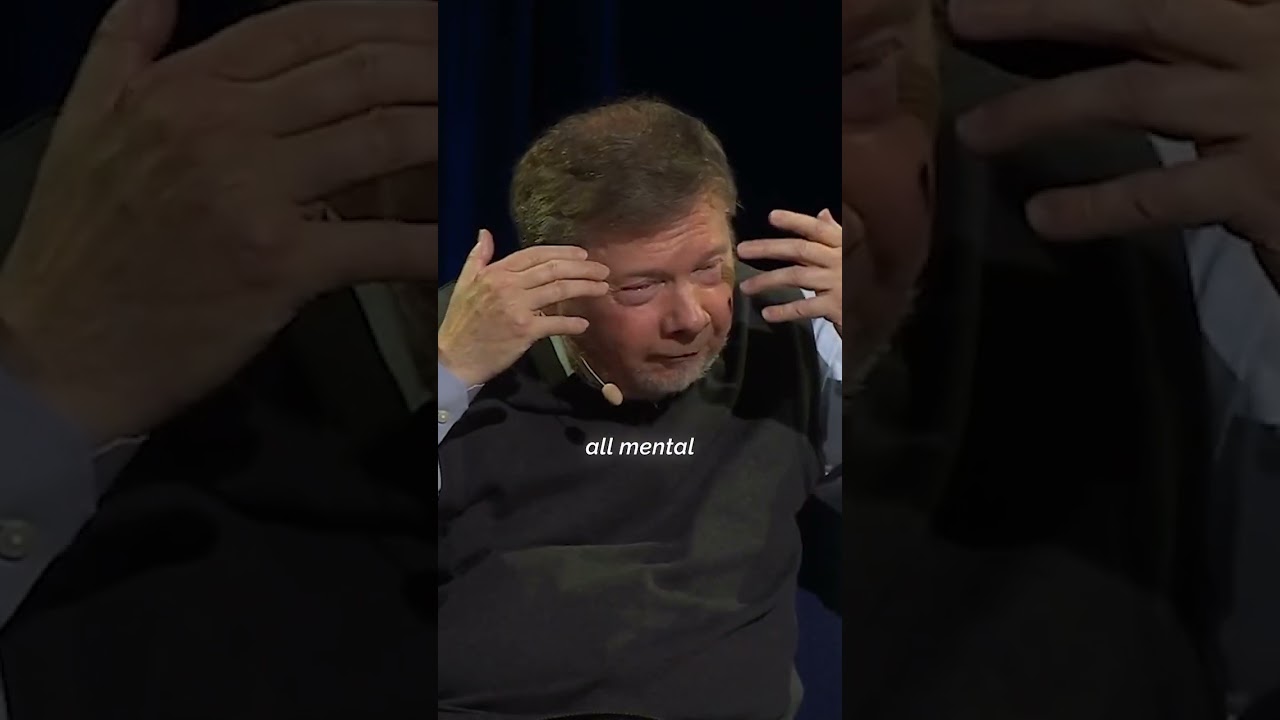
Eckhart Tolle argues that knowledge alone—whether acquired through books, training, or credentials—does not equip someone to be an effective coach, therapist, or helper. The secret to genuine healing and transformation lies in presence: the quality of complete attention and awareness brought to an encounter with another person. When you are fully present with someone, without mental noise or judgment filtering the interaction, a deeper level of consciousness becomes accessible. In that space, insight, healing, and clarity arise naturally, not through technique but through the transmission of awareness itself. This talk challenges the cultural assumption that expertise equals healing capacity and points instead to the fundamental human need to be truly seen and met.
Why Knowledge Alone Doesn't Make Someone a Healer
The modern world tends to equate professional competence with expertise—the accumulation of information, credentials, and technique. A therapist reads psychology textbooks, a coach studies leadership frameworks, a helper learns best practices. Yet Tolle observes that many highly educated, knowledgeable practitioners fail to create the conditions for deep change in the people they work with.
The problem is not that knowledge is useless. Rather, knowledge can become a barrier when the practitioner relies on it as a substitute for direct presence. When a helper is primarily operating from the thinking mind—filtering experience through concepts, diagnoses, and mental frameworks—that mental activity creates a subtle distance between helper and helped. The person being helped senses this distance, even if unconsciously. They feel observed and categorized rather than truly met.
Tolle suggests that the presence of accumulated knowledge, if it remains unintegrated with presence itself, can even obstruct healing. A coach who is mentally rehearsing talking points, or a therapist whose attention is divided between listening and formulating the next interpretation, is not fully there. The other person may sense a kind of absent attentiveness—the helper is present in body but their consciousness is elsewhere, caught in the mental realm.
What Is Presence and How Does It Differ From Attention?
Presence, in Tolle's teaching, is more than mere attention. Attention can be directed from the thinking mind; you can pay attention to something while remaining largely unconscious. Presence, by contrast, is a quality of awareness itself—a state in which the mind is quiet, responsive, and non-judgmental, allowing a deeper layer of consciousness to be active.
True presence involves giving complete attention to another person without filtering that attention through concepts, interpretations, or mental commentary. When you are present, you are not thinking about the other person—you are conscious with them. You perceive them as they are in this moment, not as a case study or a problem to be solved.
This distinction matters profoundly. When you give someone your complete presence, without the interference of your own mental noise, a field opens between you. In that field, the other person feels genuinely met. They are not being analyzed or categorized; they are being received. This reception itself—this quality of being truly seen—often begins the healing process before any words are spoken or any technique applied.
The Role of Mental Interference in Blocking Healing
Tolle identifies mental interference—the constant internal commentary, judgment, and interpretation—as a major obstacle to healing presence. When a helper's mind is active with evaluations ("This person has abandonment issues," "They're using a defense mechanism"), that mental activity, however intelligent, creates a barrier.
The thinking mind categorizes, compares, and judges. It operates in time, drawing on past patterns and projecting future outcomes. But healing often requires stepping outside of time, outside of concepts, into the immediate actuality of the present moment. When the helper's mind is busy, the helper is not available for that dimension of presence.
Mental interference also shows up as the helper's own unconscious reactions. A therapist with unresolved wounds may unconsciously recoil from certain client material. A coach may unconsciously project their own ambitions onto the person they're coaching. These subtle mental movements, if unexamined, contaminate the field of presence and prevent the other person from feeling fully safe to explore their own truth.
How Complete Attention Without Judgment Opens Deeper Awareness
When a helper brings complete, non-judgmental attention to another person, something shifts. The person being helped often experiences a sudden clarity—insights arise that they had not consciously formulated. Why? Because in the absence of judgment and mental noise, the other person's own deeper intelligence becomes accessible to them. They are no longer operating solely from the thinking mind; they are receiving input from a deeper level of awareness.
This process is not mystical, though it may feel subtle. What happens is that the quality of presence offered by the helper creates a resonance. The other person, in the presence of someone who is truly listening without judgment, often finds their own internal noise beginning to quiet. Their nervous system relaxes slightly. In that quieter state, their own innate knowing—what Tolle might call their being, or their deeper self—becomes more audible to them.
The helper's role, then, is not to fill the other person with knowledge or solutions. It is to hold a space of such clear, non-judgmental presence that the other person's own inner wisdom can surface. This is why presence is the secret: it allows the other person access to their own deepest resources.
Can Healing Arise Without Technique or Intervention?
Tolle's teaching suggests that the most potent form of healing occurs in the space of presence itself, before technique comes into play. A skilled therapist or coach certainly has techniques, and these can be useful. But the techniques work not because of their cleverness, but because they arise within and are delivered through a field of presence.
In other words, the same intervention offered from a fragmented, mentally noisy state will have a different effect than the same intervention offered from a state of complete presence. The difference is in the consciousness in which the intervention is held, not in the words themselves.
This does not mean that knowledge and skill are irrelevant. Rather, it means they must be subordinate to presence. A helper who is fully present can draw on their knowledge organically, applying it in ways that are responsive to the actual person in front of them, not according to a predetermined formula. The knowledge becomes alive, responsive, and truly useful.
The Transmission of Awareness Itself
One of Tolle's central insights is that consciousness itself can be transmitted from one person to another. When someone is in a state of deep presence, that presence can be "caught" by others in their vicinity. A child in the presence of a calm, conscious adult often becomes calm. A person in distress, when met with genuine presence, often feels their nervous system settle.
This transmission is not about words or information. It is about the actual quality of consciousness being offered. The helper who is present is, in a sense, demonstrating what presence looks like, and that demonstration can activate the capacity for presence in the other person. Over time, repeated experiences of being truly met in presence can help someone develop their own capacity to be present—to themselves, to others, and to life itself.
This is why presence is sometimes described as the most powerful healing force: it is not conditional on technique, language, or theoretical framework. It works across all cultures, all languages, all belief systems. A person who is truly present can help another person heal, regardless of the specific healing modality being employed.
Presence as the Foundation for All Helping Professions
Tolle's teaching has implications for anyone in a helping profession—therapists, coaches, teachers, parents, mentors. The standard approach is to accumulate more knowledge: more certifications, more trainings, more techniques. Yet Tolle suggests that the real development is in the quality of presence brought to the work.
A teacher who is fully present with a student creates a learning environment that no amount of sophisticated curriculum design can match. A parent who is truly present with a child conveys safety, acceptance, and the child's own worth in ways that no parenting technique can replicate. A therapist who is present holds a healing space that no theory alone can generate.
This does not invalidate knowledge or training. It reframes them. Knowledge and skill are tools that the helper carries; but the real work happens in the consciousness of the helper, in the degree to which they can be fully awake, fully present, and free of their own mental interference while with another person.
Where to Go From Here
If you recognize yourself in Tolle's teaching—perhaps you work in a helping profession, or you're simply interested in deepening your capacity to support others—the practice is one of deepening presence. This might involve meditation practice, which trains the mind to settle into the present moment. It might involve conscious inquiry into your own unconscious reactions and mental filters, so that you can gradually free yourself from them. It might simply involve moments of deliberately setting aside your thinking mind and bringing your full awareness to a conversation with someone you care about.
The invitation is to begin noticing: when you are with another person, how much of your attention is actually present with them, and how much is caught in your own mind? Can you sense the difference between offering someone your divided attention versus your complete presence? What shifts when you bring your full awareness to a conversation? As you experiment with this, you may discover that the deepest gift you have to offer is not your knowledge or your technique, but your presence—your capacity to be fully conscious and available in this moment, with this person, exactly as they are.