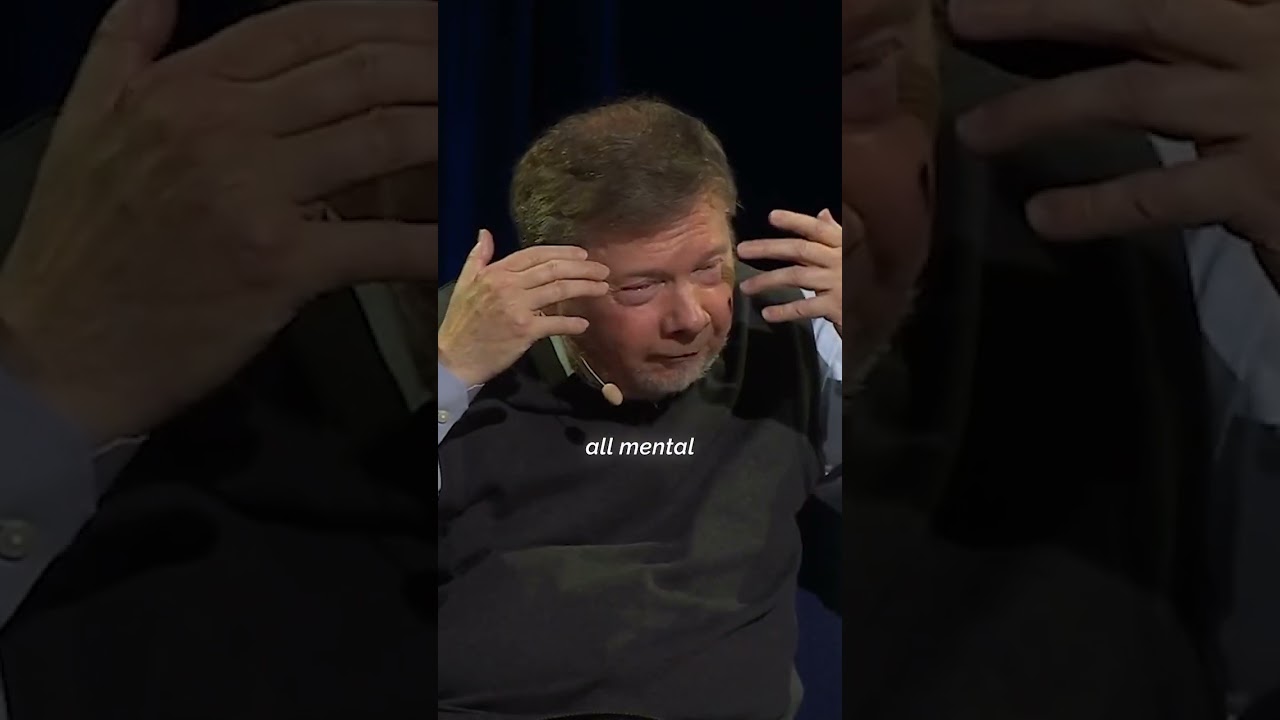
Most people are enslaved by compulsive thought rather than using thought as a conscious tool. Eckhart Tolle examines the dysfunction in how humans relate to their minds—how thinking has become automatic, identity-based, and often divorced from present-moment reality. He explores why the mind dominates human consciousness and offers insight into how awareness itself can free us from this unconscious pattern.
What Does It Mean to Be Enslaved by Thought?
The human condition, as Tolle frames it, involves a fundamental dysfunction: most people do not use their minds as tools. Instead, the mind uses them. Thought has become a compulsive, automatic process that runs continuously—narrating experience, judging it, projecting into past and future—whether or not it serves a practical purpose. This is not thought in its proper function (solving problems, planning, creating). This is thought as tyrant.
The distinction matters. A tool exists to serve a function and then stops. A hammer drives a nail, and then you put it down. But the human mind, for most people, never stops. It continues generating narratives, commentary, and mental loops long after any practical use has ended. When you finish a conversation, your mind doesn't rest—it replays the exchange, judges your words, creates alternative versions of what you might have said. When you face an uncertain future, the mind projects anxious scenarios without pause. This ceaseless activity is not intelligence; it is dysfunction.
Tolle's core observation is that consciousness has become identified with thought. People believe they *are* their thoughts. This identification creates suffering because it locks awareness into the mind's limited, dualistic perspective. The mind operates through separation: self and other, right and wrong, past and future. When consciousness merges entirely with this mechanism, the present moment—where life actually occurs—becomes invisible.
How Does Identification with Thought Create Suffering?
The ego, as Tolle uses the term, is the psychological structure built from identification with thought and past identity. When you are identified with your thoughts, you believe:
- Your self-worth depends on your thoughts being correct
- Threats to your ideas are threats to your existence
- Your story (the narrative your mind tells about who you are) is who you actually are
- Thinking more intensely will solve problems that thought itself created
This creates what Tolle calls "the dysfunctional dance"—a recursive pattern where the mind generates problems (anxiety, shame, regret) and then attempts to solve them through more thinking. A person worries about an upcoming event. Worry is not useful planning; it is compulsive thought creating a false, feared version of future reality. The person then tries to "think their way out" of the worry, generating more mental activity, more scenarios, more emotional reactivity. The mind has created the suffering and now presents itself as the solution.
This pattern is visible in rumination, obsession, and emotional reactivity. Someone says something mildly critical, and the mind seizes on it, interprets it as rejection, and builds an entire narrative of being disliked or inadequate. The original comment may have been neutral or said without malice, but the mind has created a story and then fused awareness with that story, making it feel like reality. The result is genuine emotional pain—but the pain originated in the mind, not in objective reality.
What Is the Relationship Between Thought and the Present Moment?
Thought always operates in time. By definition, it divides experience into past, present, and future. The mind thinks *about* experience but does not directly perceive the present. When you are fully aware in the now—genuinely present to what is happening—thought subsides. You see a sunset, and for a moment, there is no commentary, no comparison to sunsets you've seen before, no anticipation of photographing it. There is just the seeing. Then the mind kicks back in and says, "That's beautiful. I should remember this," and the present is already gone.
This is not a condemnation of thought. Thought is essential for human functioning—language, planning, analysis, creation. But Tolle's point is that thought is *useful only for practical purposes*. When it extends beyond that—when it runs continuously, narrating and judging—it blocks access to the present moment and to the deeper intelligence that exists beneath thought.
Most people spend almost their entire lives in thought—lost in mental narratives about past and future. The present moment, which is where actual life happens, is habitually bypassed. You eat a meal while thinking about the next task. You walk while mentally rehearsing a conversation. You spend time with someone you love while internally judging, planning, or retreating into mental distraction. This is not truly living; it is living in the mind's simulation of life.
How Can We Reclaim Our Minds as Tools Rather Than Masters?
The first step is awareness. You cannot change what you do not see. Many people are completely identified with their thoughts—they have no distance from them, no perspective. The mind generates a thought ("I'm not good enough"), and that thought is accepted as truth without question. There is no observer; there is only the observed.
Developing what Tolle calls "the witness" or "conscious awareness" means creating space between awareness and thought. This is not about suppressing or controlling the mind. It is about noticing the mind's activity without being fused with it. You can observe a thought arising—"I'm worried about this meeting"—and notice it as an event in consciousness, rather than as who you are or as a mandate for action.
This creates freedom. If you are identified with worry, you feel compelled to think more, to plan obsessively, to try to control outcomes. If you can observe worry as a mental pattern, you might notice: the worry isn't based on present-moment reality; it's a projection. The meeting hasn't happened yet. I'm currently safe. The worry is offering nothing but discomfort. From that clarity, you can choose. If planning is useful, plan. If worry is not useful, let it go without fighting it.
The practical door into this awareness is the present moment. Tolle emphasizes that presence is not a mental state to achieve—it's a shift in where awareness is directed. Instead of being caught in the thought-stream, awareness returns to direct experience: the sensation of your breath, the feeling of your body, the sounds around you, the light on the wall. These are not thoughts about experience; they are immediate experience itself.
When awareness rests in the present moment, thought naturally becomes quieter. Not suppressed, but less active because there is no imaginary problem in the now to solve. The human nervous system is designed to activate thought in response to genuine, present-moment challenges. But most of the time, the mind is generating problems that don't exist. A shift to presence doesn't eliminate functional thought—it just stops the compulsive, dysfunctional kind.
What Is the Relationship Between Thought Dysfunction and the Human Condition?
Tolle frames the dysfunctional relationship with thought as a core feature of the human condition—not an individual pathology, but a collective pattern. Animals do not compulsively think about the past or future the way humans do. A lion that has just eaten is not troubled by regret about the hunt. An animal responds to present circumstances with instinct and intelligence suited to the moment. It does not generate anxiety about things that might happen.
Humans have developed complex, symbolic thought—language, abstraction, imagination. This is a remarkable capacity. But the same mechanism that allows planning and creativity also creates chronic worry, shame, resentment, and dissociation from the present. The mind can imagine futures that never occur, and then feel genuine fear about them. It can replay past events and generate real emotional pain about something that is no longer happening.
This is "normal" in human society—nearly universal. But "normal" does not mean healthy or necessary. Tolle's observation is that this dysfunction has reached a kind of critical mass in modern consciousness. People are more identified with thought, more lost in mental narratives, more disconnected from presence and from their own being. The pace of modern life, the constant stream of information and stimulation, the cultural reinforcement of thinking as the highest value—all of this intensifies the pattern.
The dysfunction becomes visible in the prevalence of anxiety, depression, distraction, and a kind of underlying unease that no amount of achievement or acquisition seems to resolve. Because the problem is not in external circumstances; it is in the loss of presence, in consciousness that has become completely colonized by thought.
Is There an Intelligence Beyond Thought?
A critical point in Tolle's teaching is that intelligence does not equal thought. Consciousness is intelligent. The body is intelligent—it coordinates trillions of processes without the mind consciously directing any of it. Intuition is intelligent—a direct knowing that arises before thought. Presence is intelligent—a state of openness and responsiveness that allows for spontaneous, appropriate action.
Much of what the mind considers "thinking" is actually repetitive, conditioned pattern. The same worries, the same judgments, the same stories recycle endlessly. This is not creativity or problem-solving; it is the mental equivalent of a scratched record. True intelligence can arise from thought, but it is not generated by compulsive thinking. It emerges from a clear, present, uncluttered mind—from consciousness that is not consumed by the noise of mental loops.
Many people intuitively understand this. They notice that their best ideas come when they're not trying to think—in the shower, on a walk, just after waking. They recognize that when they're anxious and overthinking, they make worse decisions than when they're calm and present. They feel the difference between mental noise and genuine clarity. But the cultural assumption persists that more thinking is always better, that the solution to any problem is to think harder.
Where to Go from Here
The invitation Tolle offers is not to eliminate thought—that would be neither possible nor desirable. It is to develop a conscious relationship with thought. This means:
- Noticing when you are identified with your thoughts versus when you are the aware space in which thoughts appear
- Allowing the mind to rest during moments when thinking is not serving a practical purpose
- Returning to the present moment as a default, using breath, sensation, and perception as anchors
- Observing the ego's patterns—how the mind defends identity, generates story, projects into future—without judgment
- Trusting the intelligence that exists in presence and in the body more than you trust the mind's narratives
This is not about achieving a special state or becoming someone new. It is about allowing consciousness to return to its natural clarity when it is not filtered entirely through thought. It is about remembering that you are the awareness in which thoughts arise, not the thoughts themselves. From that recognition, the dysfunctional dance with thought loses its power, and the present moment—where real life is happening—becomes available again.