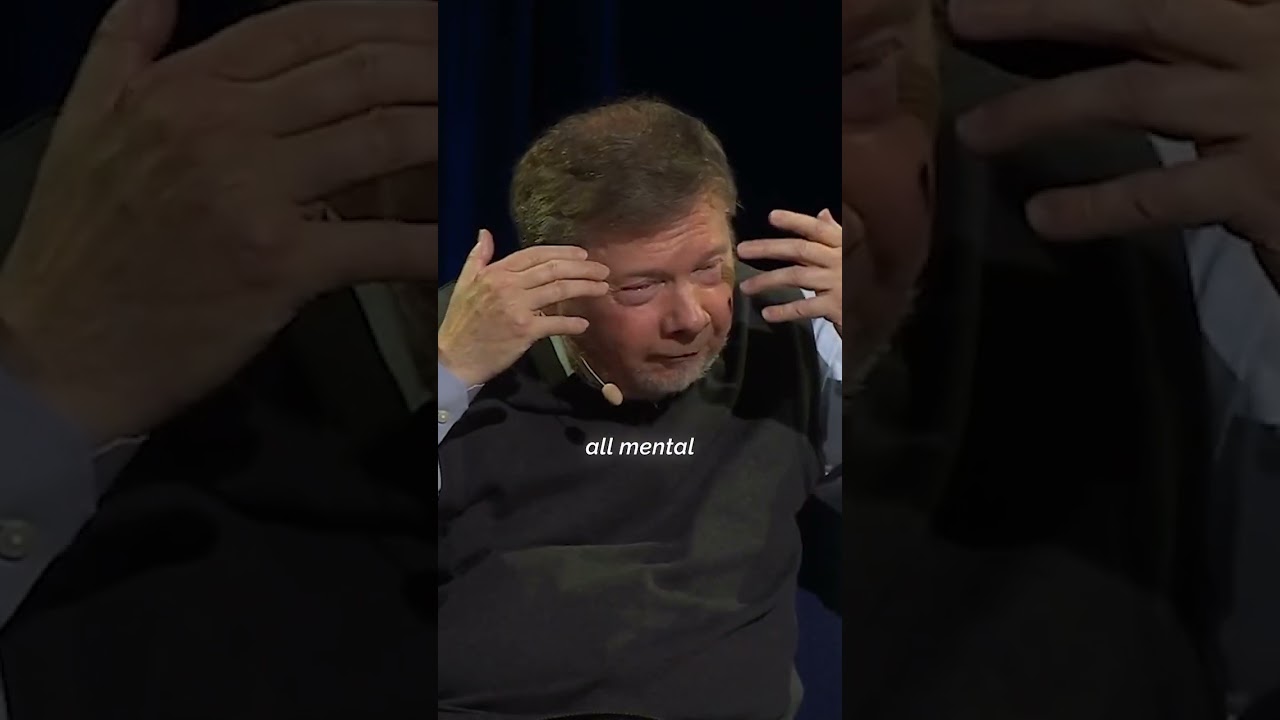
Eckhart Tolle examines why the mind cannot directly understand or deliver awakening, only point toward it through concepts. Awakening transcends thought itself, making intellectual comprehension fundamentally inadequate for the actual experience. The teachings reveal that suffering and confusion may paradoxically accelerate awakening by exhausting the mind's dominance, and that obstacles blocking openness often contain the very conditions necessary for genuine spiritual realization.
The Limitation of Concepts in Pointing to Awakening
At the heart of Tolle's teaching lies a crucial distinction: concepts and words about awakening are not awakening itself. The mind operates through concepts—categories, definitions, interpretations, and linguistic frameworks—yet awakening fundamentally transcends the domain of thought. When someone reads about enlightenment, listens to spiritual teachings, or contemplates the nature of consciousness, they are engaging the conceptual mind. This engagement, while potentially useful as a pointer or signpost, remains entirely separate from the direct experience it describes.
The problem emerges when spiritual seekers expect understanding through the mind to deliver them into awakening. This represents a category error: asking the wrong instrument to perform a function outside its design. The mind is exquisitely suited for processing information, solving problems, and navigating the practical world. But awakening is not a problem to solve through logic or a concept to master through study. The more the mind tries to grasp awakening intellectually, the further it moves from the actual experience, because awakening requires a shift in consciousness itself—a stepping back from the constant activity of thought.
How the Mind Creates Distance from Direct Experience
Tolle points out that the mind's fundamental nature is to create separation through language and categorization. When the mind encounters awakening, it immediately attempts to capture it in words and concepts. This impulse, while natural, necessarily distorts the direct experience. The mind cannot help but translate the living reality of awakening into abstract categories: "enlightenment is this," "consciousness works that way," "I will achieve awakening by following this method."
Each of these conceptual frameworks, no matter how accurate or helpful, stands between the seeker and the direct experience. They become substitutes for presence itself. A person may accumulate vast knowledge about awakening—reading all the major spiritual texts, memorizing teachings, understanding complex philosophical systems—yet remain trapped in the prison of the thinking mind. The mind's very attempt to understand becomes an obstacle.
This is not a failure of intelligence or dedication. Rather, it reflects the inherent limitation of thought as an instrument. Just as the eye cannot see itself and the knife cannot cut itself, the mind cannot think its way into a state that exists prior to and independent of thought. Awakening is not something the thinking mind can attain through effort or study; it emerges when the dominance of thinking naturally subsides.
Suffering and Confusion as Catalysts for Awakening
Tolle's teaching addresses a paradox that many seekers encounter: the very suffering and confusion that drive the spiritual search may actually accelerate awakening. This occurs because suffering exhausts the mind's capacity to maintain its habitual patterns. When a person reaches a limit of how much conceptual thinking or egoic striving can relieve their pain, the mind begins to quiet. In that quietness, the space opens for something beyond thought.
The mind's continuous activity—its endless commentary, judgment, worry, and future-focused thinking—normally monopolizes consciousness. Suffering interrupts this dominance. When confronted with genuine difficulty that concepts cannot solve, the thinking mind encounters its own futility. This recognition, though often painful, creates an opening. The seeker may find themselves sitting in silence not because they chose an advanced meditation technique, but because their mind simply ran out of solutions.
In this context, confusion serves a similar function. When the familiar mental frameworks no longer work—when a person realizes their usual strategies fail, their goals prove hollow, or their intellectual understanding doesn't match lived reality—the protective shell of conceptual certainty cracks. This crack, though uncomfortable, permits light to enter. The breakdown of the mind's false certainty can paradoxically become a breakthrough into genuine understanding.
Obstacles as Gateways to Opening
Tolle emphasizes that the obstacles people encounter on the spiritual path are not merely hindrances to overcome. Rather, they often contain the very conditions necessary for awakening. A person might observe: "I keep hitting the same emotional block. I feel stuck." The obstacle seems like something to eliminate. Yet Tolle suggests that the obstacle itself—the resistance, the blocked energy, the repeating pattern—points to where consciousness has become constricted. The tightness is not separate from the opening; it reveals exactly where opening is needed.
This requires a fundamental shift in perspective. Rather than viewing obstacles as enemies to defeat through willpower or mental strategies, a seeker might ask: "What is this obstacle showing me about how I relate to experience?" The obstacle becomes a teacher. The very resistance that seemed to block awakening becomes the doorway through it, because genuine opening requires embracing what was previously rejected or denied.
When someone encounters a pattern of suffering that repeats despite intellectual understanding, the mind often intensifies its efforts—trying harder, thinking more carefully, applying more discipline. But Tolle's teaching points toward a different possibility: allowing the obstacle to show you the limitation of the thinking approach itself. In that allowing, something shifts. The mind's grip loosens not because you forced it to, but because you stopped demanding that the mind solve what transcends the mental domain.
The Paradox of Teaching About the Untouchable
Tolle's work contains an inherent paradox: he uses words and concepts to point toward something that cannot be fully captured in words and concepts. The very act of teaching about awakening risks creating the false impression that awakening can be understood conceptually. Yet he persists in this paradoxical teaching because concepts, properly understood, can serve as effective pointers. A finger pointing at the moon is not the moon, but it does indicate direction.
The key distinction lies in how a teaching is received and used. If someone hears that "awakening involves stepping back from thought" and then tries to intellectually understand what that means, adding layers of conceptual elaboration, they have misused the teaching. But if someone hears the same words and recognizes in them an invitation to notice the constant stream of thought, to experience the gap between thoughts, to sense the presence that exists independent of thinking—then the teaching has served its function. The same words point either toward more thinking or away from it, depending on how they are met.
The School of Awakening's Deeper Exploration
According to the description of Tolle's "School of Awakening" course, the full teaching expands beyond this fundamental insight. It reveals the specific obstacles that arise to block opening, providing not just abstract understanding but practical recognition of how these obstacles actually function in a seeker's life. This moves the teaching from the theoretical realm into direct applicability.
Moreover, Tolle explores why suffering and confusion accelerate awakening—not as consoling platitudes, but as mechanisms. Understanding this mechanism shifts a seeker's relationship to their difficulties. Rather than viewing hardship as a detour from the path, they may recognize it as part of the path's essential structure. This doesn't mean suffering becomes pleasant or desirable; rather, its role in the awakening process becomes transparent.
Where to Go From Here
If this teaching resonates, the immediate application involves observing your own mind more carefully. Notice the constant commentary. Notice how concepts about awakening—spiritual knowledge you've acquired—actually function in your consciousness. Do they create presence, or do they create a feeling that you understand presence intellectually without directly experiencing it? Notice the gaps between thoughts, however brief. These gaps already point beyond the conceptual mind.
With whatever obstacles or suffering currently appear in your experience, experiment with a different relationship to them. Rather than immediately trying to solve them or understand them mentally, ask what they are showing you about how consciousness has become contracted. Where is the opening that this apparent blockage points toward? This shift from "How do I eliminate this obstacle?" to "What is this obstacle revealing?" invokes the deeper teachings Tolle explores about how obstacles actually accelerate awakening when met with genuine inquiry rather than resistance.