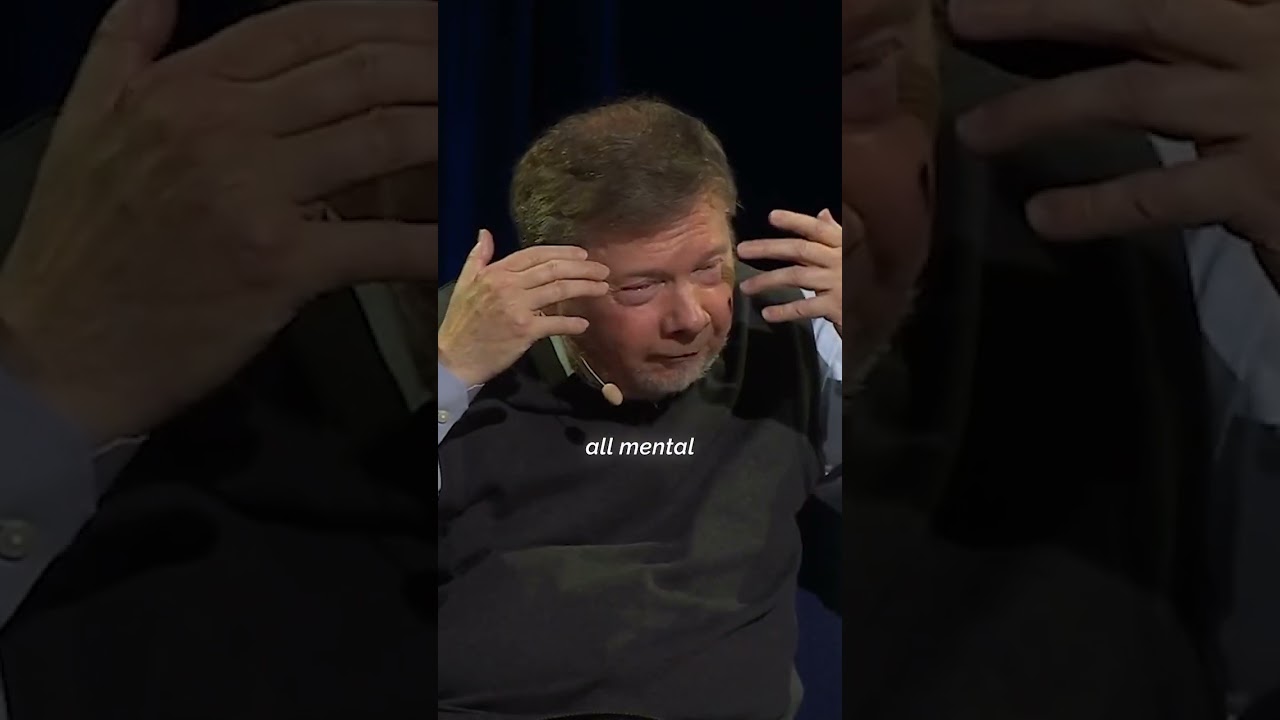
Eckhart Tolle draws on Earth's history of five mass extinctions to argue that collapse and chaos are not endpoints but transition points toward higher forms of organization and consciousness. Rather than seeing current global crises as purely destructive, he suggests examining the pattern of renewal that has historically followed catastrophic breakdowns—offering a framework for understanding humanity's present moment not as an ending, but as a threshold toward something more evolved.
The Historical Pattern of Extinction and Renewal
One of Tolle's core observations is that the planet has already survived five major extinction events. This is not a metaphorical point—it is geological fact that anchors his argument. Each extinction wiped out vast ecosystems and dominant species. Yet each time, the apparent finality of collapse proved provisional. Life reorganized. New forms emerged. Systems adapted in ways that the previous order could not have anticipated.
This pattern is instructive precisely because it operates at scales far beyond human timescales or individual psychology. The planet's capacity to move through catastrophe and generate new configurations suggests that collapse itself may be a mechanism of evolution rather than its negation. Tolle is suggesting that we examine this pattern not as historical trivia but as a template for understanding what "comes after"—both literally and psychologically.
How Does Chaos Become Higher Organization?
The description frames the core insight: "chaos gave way to something higher." This is not a statement about progress in a linear sense. Instead, it points to a reconfiguration of systems toward greater complexity, resilience, and integration. After mass extinctions, new niches open. Species diversify in unexpected directions. Ecological relationships form that were previously impossible.
For human systems, Tolle's implication is that current breakdown—economic, political, environmental—may function similarly. When existing structures are no longer sustainable, they collapse. The chaos that follows is disorienting precisely because the old frameworks no longer apply. But this clearing of obsolete forms is also the condition for emergence of new ones. What feels like ending is simultaneously opening.
The Role of Consciousness in Transition
Tolle's spiritual framework emphasizes that consciousness itself evolves through crisis. In his teachings, ego-driven consciousness—characterized by separation, accumulation, and control—generates the conditions that lead to systemic collapse. Environmental destruction, inequality, conflict, and resource depletion are not accidental byproducts but symptoms of a consciousness trapped in identification with form.
The transition "after collapse" therefore involves not just institutional or technological change, but a shift in how human beings perceive and relate to reality. Higher consciousness, in Tolle's language, is characterized by presence, interconnection, and alignment with what is. As the old consciousness-patterns and their corresponding systems break down, the possibility emerges for a qualitatively different way of being and organizing.
This is not guaranteed. Collapse does not automatically produce enlightenment. But it does create the conditions where resistance to transformation becomes futile, making space for those capable of shifting into greater presence and awareness to pioneer new possibilities.
Why Present Crises Mirror Past Patterns
By invoking the five mass extinctions, Tolle is not equating human civilization with dinosaurs or previous dominant species. Rather, he is highlighting a recursive pattern: dominant systems tend toward unsustainability until breakdown forces reorganization. Each past extinction destroyed the reigning form while creating space for what came next.
Current global crises—climate instability, ecological collapse, social fragmentation—reflect the exhaustion of a consciousness-pattern and the industrial systems it generated. From this perspective, these crises are not anomalies or failures of the old system to function properly. They are symptoms that the system itself has reached its limits and cannot evolve further without fundamental transformation.
This reframe has psychological and practical implications. Instead of framing collapse as something to prevent at all costs or to feel hopeless about, Tolle's view opens the possibility of conscious participation in transition. If collapse is historically inevitable and renewal is the typical outcome, then the meaningful question becomes: what consciousness, what values, what systems emerge in the space that opens?
What "Higher" Means After Collapse
The language of "something higher" requires clarification. In Tolle's framework, higher does not mean technologically superior or materially more abundant. It means more aligned with reality as it actually is, less distorted by fear and egoic contraction, more capable of wholeness and integration.
A civilization built on presence rather than compulsion, on cooperation rooted in genuine interconnection rather than enforced hierarchy, on enough rather than endless growth—these represent higher organization not because they are more advanced but because they are more conscious. They operate from a more accurate understanding of what humans actually need and what the living world can sustain.
The post-collapse period, in this view, is less about rebuilding in the same pattern and more about organizing at a different level of consciousness. This might involve simpler material cultures coupled with greater psychological and spiritual development, more localized and resilient systems, institutions oriented toward flourishing rather than extraction, and human relationship to nature grounded in participation rather than dominion.
The Role of Individual Presence in Collective Transition
While Tolle's title points to planetary and historical scales, his implicit argument connects individual consciousness to collective possibility. The shift from ego-consciousness to presence is not primarily a political or technological project—it is a transformation available to individual human beings now.
As more individuals embody greater presence and awareness, they become vectors for different modes of organization and relationship. They make different choices, create different institutions, relate to crisis from a different reference point. The collapse of the old system and emergence of the new is inseparable from this shift in consciousness happening at the individual level.
This is not optimistic in the sense of denying real suffering or difficulty in periods of transition. Collapses are painful. But it offers a framework for participating consciously in that transition rather than being merely victimized by forces beyond understanding.
Where to Go From Here
If Tolle's view holds—that chaos historically gives way to higher organization—then the present moment calls for both realistic assessment of what is ending and creative imagination of what wants to emerge. This involves developing presence and awareness in the face of difficulty, examining the consciousness-patterns that generated unsustainability, and beginning to embody and pioneer different ways of being and organizing.
It also means studying actual transitions: how communities have reorganized after collapse, how resilient cultures maintain coherence through instability, what consciousness and practices support flourishing in scarcity. The historical pattern Tolle invokes is not a guarantee but an invitation to participate consciously in what comes next, rather than cling to what is already gone.