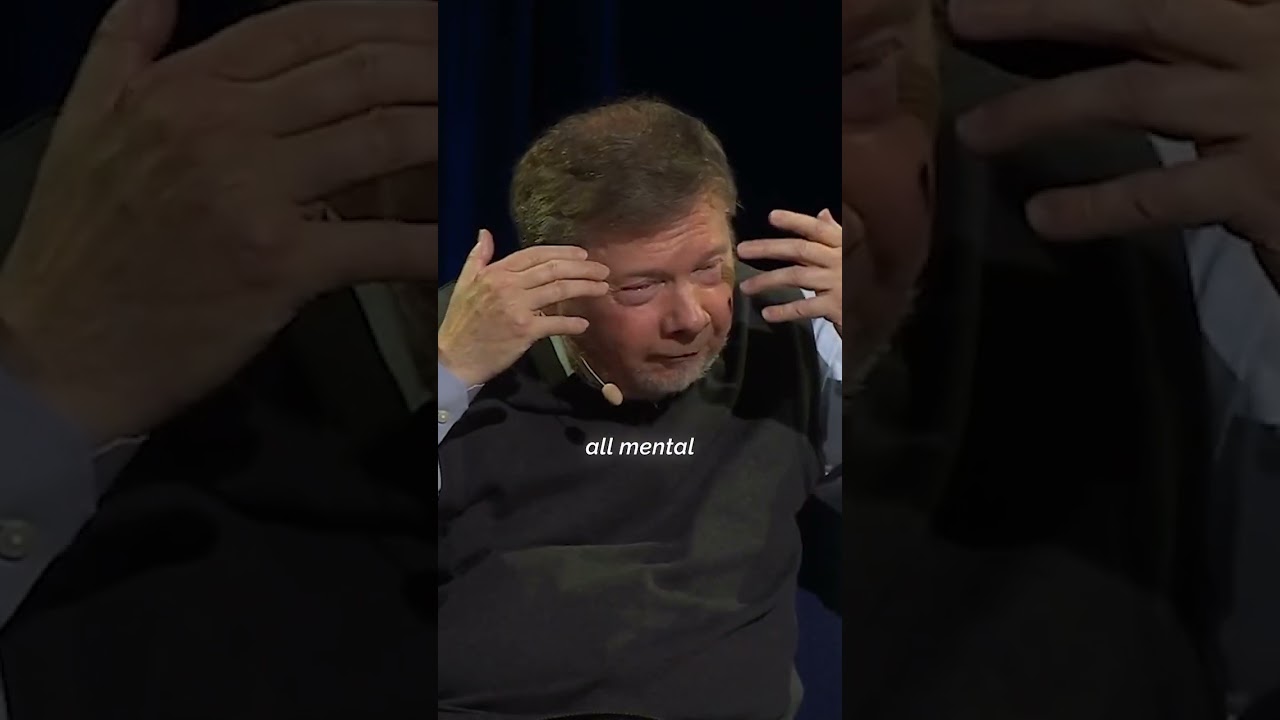
Eckhart Tolle describes an unexpected meditation practice that requires no technique: gazing into vast space. As a teenager in Spain, he experienced the night sky stopping his mind in a way no deliberate meditation method ever could. Rather than relying on concentration exercises or breathing protocols, simply observing the vastness and emptiness of space can quiet mental activity more effectively than any formal practice. This is not mystical—it is the direct encounter between consciousness and emptiness that naturally dissolves the constructed self.
What Happened When Eckhart Tolle Looked Up at the Night Sky
Tolle recounts a formative experience from his teenage years in Spain. Standing beneath the night sky, he found his mind suddenly stopped. Not through effort or technique, but through direct perception. The vastness above him had a quieting effect on his mental chatter that no meditation practice he had encountered achieved. At the time, he did not recognize this as meditation—it was simply what happened when his consciousness encountered the immensity of space.
This experience points to something rarely discussed in meditation instruction: that the stopping of mind can occur spontaneously when the perceiver is confronted with vastness that exceeds conceptual understanding. The mind cannot narrativize infinite space. It cannot grab hold of nothingness. And in that failure, thought momentarily ceases.
Why Space Works Better Than Technique
Most meditation traditions teach method. Sit upright. Count the breath. Repeat a mantra. Watch the sensation of the body. These are scaffolds for attention—structures designed to redirect the mind when it wanders. They work, but they are indirect. They are tools. You must learn them, remember them, apply discipline to them.
Space requires none of this. Space is not an object you direct your attention toward in the way you focus on your breath. Rather, space is the medium in which all objects appear. When you gaze into genuine emptiness—whether the night sky, the vastness of the ocean, or the expanse above a mountain peak—you are not concentrating. You are receiving.
The mind stops not because you have mastered a technique, but because there is nothing there to think about. The vastness has no narrative. It offers no foothold for the thinking mind. It is too big, too open, too fundamentally empty of conceptual content. Consciousness recognizes itself in this vastness, and the separate self—the entity that thinks and worries and plans—temporarily disappears.
The Difference Between Trying to Meditate and Encountering Space
There is a subtle but crucial distinction. In formal meditation, the practitioner is often in a state of subtle striving. Even when the instruction is to "let go," there is an effort toward letting go. The doer is still present, attempting to achieve a state. This is why meditation can remain effortful, requiring years of practice to feel natural.
With space, the process reverses. There is no attempt to achieve anything. You simply look. The immensity of what you observe overwhelms the apparatus of self-effort. The mind does not stop because you have controlled it; it stops because the infinity before you makes control irrelevant. In this moment, there is no meditator trying to meditate. There is only awareness meeting emptiness.
Have You Already Experienced This Without Naming It?
Tolle suggests that many people have already encountered this state, but did not label it meditation. Perhaps you have stood at the edge of the ocean and felt the vastness quiet something in you. Perhaps you have driven across a desert or stood on a mountaintop and experienced a sudden loosening of mental tension. These are moments when consciousness encountered space directly, without the intermediary of technique.
The value of recognizing these moments is that it can reframe what meditation actually is. It is not necessarily a practice you do. It is not necessarily the achievement of a particular mental state. It is the natural response of consciousness when it meets vastness—when the ordinary boundaries of the thinking mind expand into something larger than itself.
Space as the Most Direct Meditation Object
Unlike breath or mantra or body sensation—which are all objects within the field of consciousness—space is closer to consciousness itself. Space is, in a sense, the native environment of awareness. When you observe space, you are not observing something separate from consciousness; you are observing the context in which consciousness naturally rests.
This is why space can be so immediately effective. There is no learning curve. There is no accumulation of skill. A child looking up at the stars experiences the same quieting as an advanced meditator. The vast sky makes no distinction between practitioner levels. It simply offers itself, and consciousness responds to this offering by releasing its grip on thought.
The mind cannot intellectualize infinity. It cannot reduce vastness to concepts. And in that defeat, it surrenders. This is not failure—it is exactly what needs to happen for genuine meditation to occur.
The Role of Presence in Gazing at Space
When you truly look at the night sky—not passively glancing, but genuinely observing—you are not lost in thought about the sky. You are not analyzing it. You are present to it. The presence that arises is not manufactured through technique; it is the natural state that emerges when thought temporarily ceases. And thought ceases precisely because there is nothing in the vastness that the mind can grip and narrativize.
This is why Tolle emphasizes that you may have already experienced this. The quiet that comes when you watch the horizon. The peace that arises when you step outside on a clear night and look up. The sense of expansion that occurs when you contemplate the open sky. These are not special experiences reserved for advanced practitioners. They are available to anyone willing to simply look.
Where to Go From Here
If this resonates, the practical implication is straightforward: spend time with space. Find a location where you can see the night sky without too much light pollution, or stand at the edge of a large body of water, or position yourself somewhere with an unobstructed view upward. Make no effort to meditate. Simply observe. Allow the vastness to do what it naturally does—quiet the small self and expand awareness into presence.
Tolle suggests that once you have tasted this, you may recognize similar moments of spaciousness in your everyday life. A moment of clarity. A gap between thoughts. A sense of openness. These are the same medicine arriving through different doors. The deeper work is recognizing that this spacious presence is always available—not just under the night sky, but as the ground of being itself. Space is not somewhere else. It is what you are.