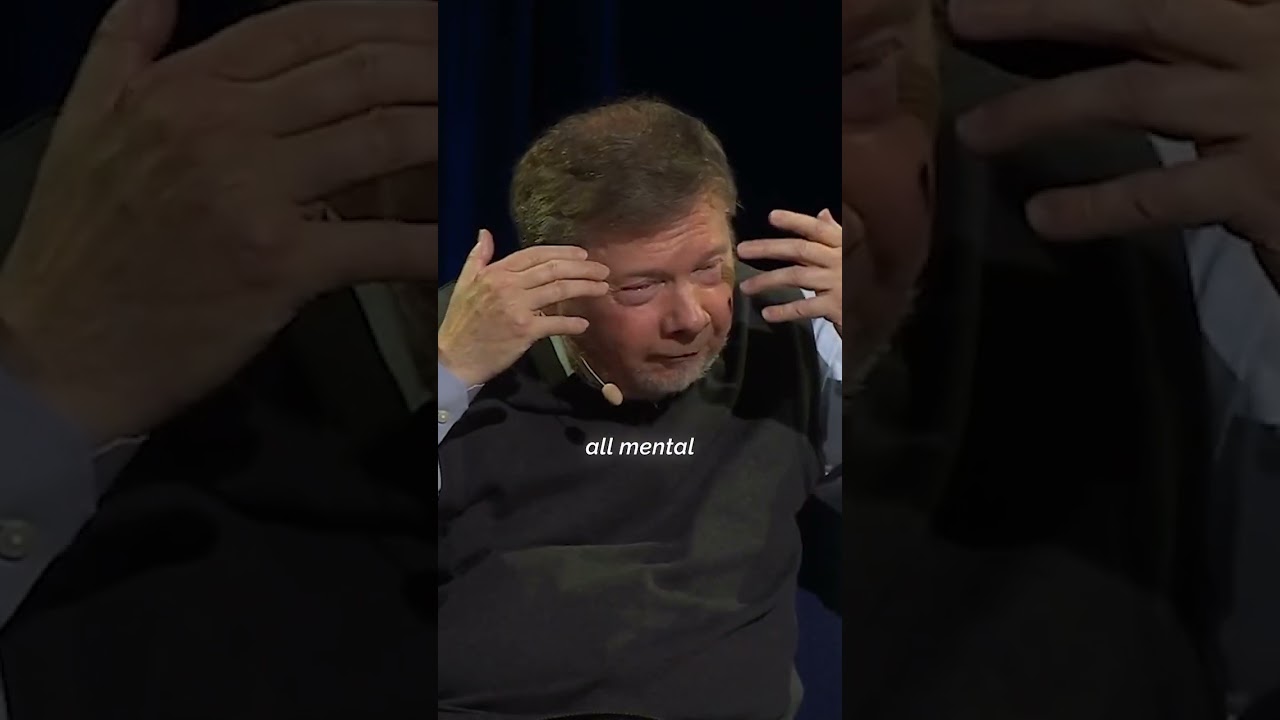
Eckhart Tolle teaches a rapid, 30-second practice to drop into full presence by directing attention to breath and bodily sensations. Rather than fighting the mind or attempting to stop thinking, the practice works by shifting the seat of awareness away from thought and into direct sensory experience. This creates immediate access to a deeper state of presence—a way of being beneath the constant stream of mental commentary.
Why the Mind's Default Mode Keeps You Stuck in Thinking
Most human suffering arises not from life circumstances themselves, but from our habitual relationship to thought. The mind, left to its default state, generates an endless stream of commentary, worry, regret, and projection. This mental noise creates a kind of trance—what Tolle calls the flow of compulsive thinking—where attention is trapped in past-oriented memory, future-focused anxiety, or self-referential narrative. The person becomes identified with thought itself, unable to distinguish between the thinking process and conscious awareness.
The problem is not thinking; thinking is a useful tool. The problem is unconscious thinking—thought that runs on autopilot, where you are not aware that you are thinking. You have become the thought, rather than the observer of thought. Breaking this pattern requires not discipline or willpower, but a shift in where you place your attention.
How the 30-Second Practice Works
Tolle's exercise is deliberately simple because complexity creates resistance. The practice has two components: awareness of breath and awareness of body sensation. These are not separate steps but two channels of the same shift in attention.
Bring awareness to your breathing. Do not try to breathe differently or control the breath; simply notice the natural flow of inhalation and exhalation. Feel the movement of air through the nostrils, the expansion of the chest or belly, the slight pause between breaths. This single act—placing attention on the breath—immediately anchors awareness in the present moment, because breath only exists now. There is no "past breathing" or "future breathing"; the breath is always occurring in the present.
Simultaneously, bring awareness into your body. Feel the sensations in your hands, feet, torso. Notice where you feel most alive or present in your physical form. Some people sense a tingling, warmth, or aliveness. Others simply feel the general solidity and weight of the body. The specific sensation matters less than the act of directing attention into the body, away from the head and the thinking mind.
The power of this dual focus is that it occupies the attention completely. When you are genuinely present to your breath and body, thought temporarily stops—not through force, but through natural displacement. Awareness has moved out of the mental dimension and into the sensory dimension. This is what presence feels like: not the absence of thinking, but the absence of identification with thought.
Why This Works in 30 Seconds
The brevity of the practice is crucial. Tolle teaches that presence is not something you build up gradually over meditation; it is something you can access instantly. A 30-second practice proves this to you directly. You do not need an hour-long retreat or years of training to touch presence. This immediate accessibility removes the excuse of "I don't have time to meditate" and reveals that presence is always available, closer than your own thoughts.
Thirty seconds is also short enough that the mind does not have time to generate significant resistance or distraction. In a longer session, patterns of restlessness, boredom, or self-judgment may arise. In 30 seconds, you slip in and out quickly, tasting what presence feels like before the thinking mind reasserts its dominance.
The Difference Between Breathing About Breath and Breathing Into Presence
A common mistake is to think about the breath rather than to feel the breath. Mental observation of breathing is still thinking. True breath awareness is sensory—it is the direct, felt experience of air moving and the body responding. When you notice yourself thinking "I am breathing in, I am breathing out," you have drifted back into the mental dimension. The practice is to drop below that commentary and feel the raw sensation of respiration.
Similarly, body awareness is not analysis of the body. It is not thinking "My hand is touching the desk" or "I feel tension in my shoulders." It is the direct sensation: the texture, temperature, and aliveness of physical form. This distinction between thinking about experience and being present to experience is the entire foundation of Tolle's teaching on presence.
How to Use This Practice Throughout the Day
The 30-second practice is not meant to be done once and forgotten. Tolle suggests using it as an anchor point—a way to return to presence whenever you notice you have been lost in thought, emotion, or mental activity. If you catch yourself in worry, rumination, or emotional reactivity, pause and spend 30 seconds with your breath and body. The effect is to reset your baseline state from identification with thought back to embodied presence.
You can practice it before important conversations, meetings, or decisions. You can practice it in moments of stress or anxiety. You can practice it in moments of boredom or restlessness. The practice works the same way regardless of circumstance because it is not dependent on external conditions; it is a shift in the internal locus of attention.
Over time, repeated use of the practice creates a "muscle memory" of presence. Your nervous system learns what the state feels like and becomes easier to access. The gaps of presence become longer, and the domination of compulsive thinking becomes less absolute. You are not trying to achieve permanent presence (which would be another thought-goal). You are simply training awareness to have access to presence as a default option.
What Presence Actually Is
Presence, in Tolle's framework, is not a heightened state of awareness or a special experience. It is the quality of consciousness itself when it is not contracted into identification with thought. When you are present, you are simply awake to what is happening now. You can still think—presence includes the capacity for thoughts—but you are not lost in thought. There is space around thoughts. You can observe them as phenomena arising and passing, rather than as the fabric of reality.
This spaciousness feels like peace, clarity, and aliveness. It is peaceful not because something good is happening, but because the internal noise has quieted. It is clear because you are no longer filtering experience through layers of mental interpretation. It is alive because sensation—breath, body, immediate environment—is more vivid when attended to directly.
The Difference Between This Practice and Meditation
Some practitioners confuse Tolle's 30-second practice with meditation practice. They are related but distinct. Meditation typically involves sitting for an extended period, often with a specific focus (breath, mantra, visualization), with the intention of training the mind or cultivating a particular state. Tolle's practice is simpler and more immediate: it is not about training or cultivation but about dropping in and recognizing presence that is already here.
That said, regular meditation deepens the capacity for presence. If you have a meditation practice, the 30-second exercise serves as a quick reset button. If you do not meditate, the 30-second practice gives you direct access to the fruits of meditation without the structural commitment. Both have value depending on your temperament and life situation.
Common Obstacles and How to Meet Them
The mind says "This is too simple." Simplicity is not a flaw; it is the whole point. The thinking mind often rejects simplicity because it cannot make the simple into a complex achievement. If the practice works, that is sufficient.
You do not feel anything special. Presence is not always accompanied by bliss, tingling, or obvious pleasure. Sometimes it is subtle—just a slight quietness, a steadiness, a sense of okayness. Do not wait for a dramatic experience. The absence of mental noise is the presence itself.
You become impatient or restless. This is the mind's resistance to being displaced from its throne. Simply notice the impatience and return attention to breath and body. The practice is not about achieving a goal; it is about noticing what happens when attention shifts.
You forget to practice it. This is also the mind's resistance. Tolle suggests creating a trigger: practice whenever you notice an emotion, before you check your phone, when you sit down to eat, when you wake up. Build the practice into existing routines rather than making it a separate task.
Where to Go From Here
The 30-second practice is an entry point, not a destination. Once you have experienced what presence feels like, you can extend the practice. Sit for five minutes with breath and body awareness. Take a conscious walk where you feel your feet contacting the ground. Eat a meal with full sensory attention. All of these are expansions of the same principle: shifting awareness from the mental realm into direct sensory experience.
If you find the practice valuable, deepen your exploration with extended meditation, retreats, or teachings that build on this foundation. Tolle's body of work in books like The Power of Now and A New Earth explores the philosophy and implications of living in presence. If you want to work with a teacher or community, his online platform and courses offer structured support. The 30-second practice is not a replacement for deeper practice, but it is proof that the door to presence is always open, and you can walk through it anytime, anywhere.