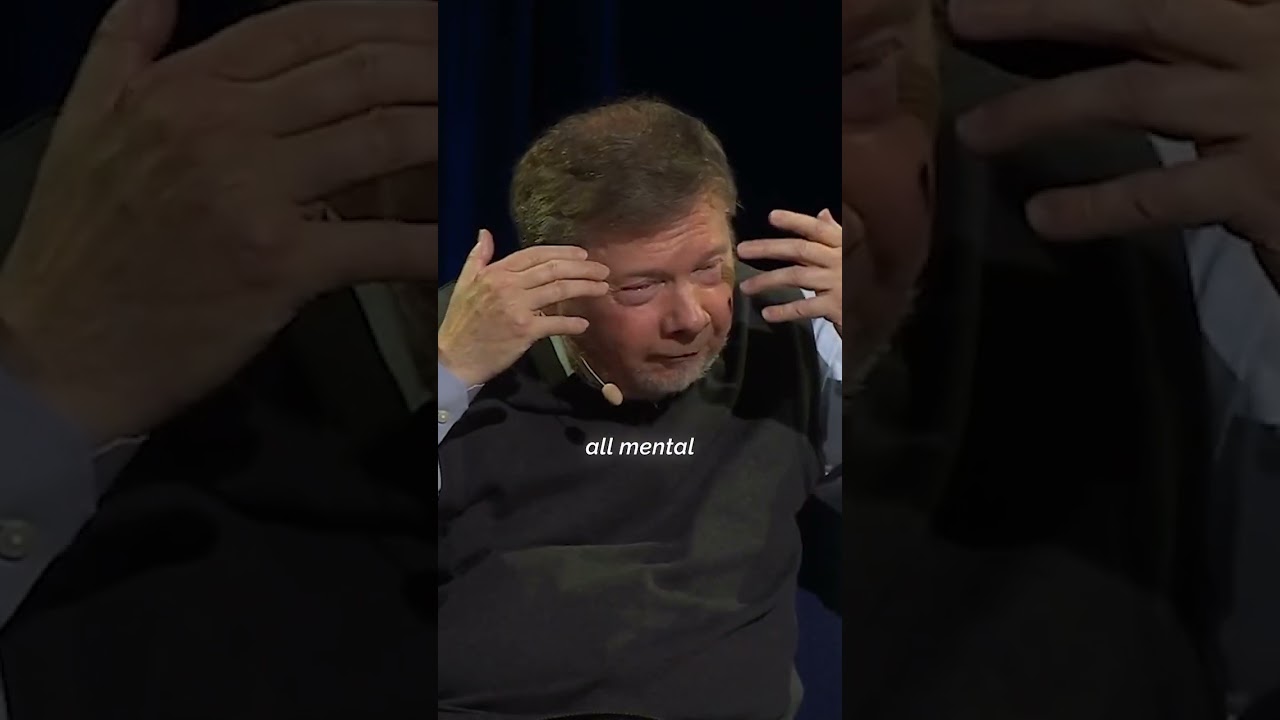
Eckhart Tolle explores why the ego fundamentally fears silence and stillness by examining how genuine thinking and insight arise not from accumulated knowledge but from a state of non-knowing. The ego's resistance to this emptiness is a mechanism of self-protection—it survives through identification with thought and the illusion of knowing. When you enter true stillness, you access the wisdom already within you, not through mental effort but through the dissolution of the mental structures that obscure it. This reframes the Socratic maxim "the wisest person is the one who knows they know nothing" not as false modesty but as a practical description of how consciousness actually works.
What Does Socrates Mean by "Knowing You Know Nothing"?
Most people dismiss Socrates' statement as a form of humility or rhetorical device. Eckhart Tolle suggests this interpretation misses something essential. The statement is not about intellectual modesty or pretense. Rather, it points to a fundamental truth about the nature of knowing and consciousness itself. When Socrates claims wisdom lies in knowing one knows nothing, he is identifying a state of mind—one unclouded by the certainty that accumulated knowledge produces.
This does not mean rejecting knowledge or functioning without it. Instead, it describes a way of being in which knowledge exists without identification with it. The wise person holds knowledge lightly, remaining open to what cannot yet be known. This openness is not ignorance; it is clarity. The person who believes they have figured it all out, whose mind is already filled with conclusions, cannot perceive what is actually in front of them. The ego, however, is invested in the opposite state: the certainty that comes from having answers, from knowing.
How Does Real Thinking Differ from Conditioned Thought?
Tolle distinguishes between genuine thinking—which produces real insight—and habitual thought, which merely recycles stored information. Real thinking does not start from accumulated knowledge. It starts from stillness. From silence. From an absence of preconceived certainty.
When you approach a problem or question already loaded with a framework of what you think you know, your mind filters perception through that framework. You see only what fits the existing structure. Genuine thinking requires a different posture: a willingness to enter not-knowing, to sit with a question without rushing to conclusions. In that space of openness, something new can emerge—not through force of will or mental effort, but through a receptivity that allows fresh perception.
This is why many breakthrough insights arrive not when you are straining to solve something but when you step away from the problem entirely. In that moment of release, when the mind quiets and the accumulated knowledge temporarily steps back, space opens for genuine thinking. The insight arrives spontaneously, unbidden. This is the difference between thought that merely recombines existing data and thinking that reveals what was not previously visible.
What Is the Ego's Fundamental Fear of Silence?
The ego's existence depends on identification with thought. The ego is a mental structure—a sense of self constructed from past experience, stored knowledge, and habitual patterns of thinking. When you are silent, when thought settles and the mind becomes still, the ego loses its primary function. It cannot survive in that environment because there is no content for it to attach to.
Silence is a threat to the ego because silence reveals what the ego obscures: the presence of consciousness itself, independent of thought. In silence, there is no story, no narrative of "me" and my history, no framework of beliefs and acquired knowledge to hold onto. The ego experiences this as a kind of annihilation. It is not a comfortable state for the structure that relies on the constant generation and maintenance of a separate self.
This fear manifests in very practical ways. Notice what happens when you try to sit in silence. The mind may become restless. Thoughts begin to churn. Anxiety may arise. This is not random noise. It is the ego's resistance to a state in which it has no purchase. The ego will generate distraction, worry, plans, judgments—anything to avoid returning to the silence in which it cannot exist.
The fear is particularly acute because the ego cannot intellectually comprehend the state of not-knowing. It cannot analyze silence or develop a mental framework for stillness. These states exist beyond the realm of thought, and the ego has no tools to navigate them. From the ego's perspective, silence is dangerous precisely because it is unknown.
Why Does Not-Knowing Contain Genuine Wisdom?
There is a paradox here: the absence of knowing is the gateway to real wisdom. This is not a spiritual platitude but a description of how consciousness actually operates. Accumulated knowledge—the things you have learned, the conclusions you have drawn—is always of the past. It is mental content, stored information. But life happens in the present moment, which is never captured entirely by past knowledge.
When you meet a person, a situation, or a challenge with a mind already full of conclusions about what it is and how to respond, you are not actually meeting what is present. You are meeting your idea of it. The actual situation remains partially invisible, filtered through the mental overlay. Real wisdom is the ability to perceive what is actually present, unmediated by the past.
Not-knowing creates the space for this kind of seeing. When you release the need to immediately categorize, analyze, and understand something through the lens of what you already know, you become available to perceive it freshly. This receptivity is not passive weakness. It is an alert, sensitive attentiveness that allows genuine understanding to arise.
Moreover, not-knowing aligns you with reality as it actually is. Reality is not static. It is dynamic, unfolding, novel. A mind full of fixed ideas about how things work cannot adapt to novelty. But a mind in a state of not-knowing is inherently flexible. It is prepared to perceive what is new because it is not clinging to what was.
How Does Stillness Reveal the Wisdom Within You?
Tolle suggests that wisdom is not something that needs to be acquired from outside yourself. It is already within you. But it is obscured by the constant activity of the thinking mind. The mind generates endless commentary, judgment, planning, and worry. This noise prevents you from accessing the clarity that lies beneath thought.
When you enter stillness—through meditation, through conscious presence, or simply through a moment of genuine silence—the mental noise begins to settle. As it does, something becomes apparent. There is an intelligence at work that is not the product of your personal thinking. There is a knowing that operates below the level of conscious thought. There is a wisdom in your own being that has been present all along but obscured by the chatter.
This is not mystical language but a direct observation. The body, for instance, is an expression of extraordinary wisdom. It knows how to repair itself, how to regulate temperature, how to maintain the complex chemistry of life—all without your conscious involvement. Your breathing, your heartbeat, the growth of your cells—these are all expressions of an intelligence that operates beneath thought. When you become still, you can sense into that intelligence.
Similarly, there is a quality of knowing that can arise from deep presence, independent of the thinking mind. It manifests as intuition, as an immediate sense of what is true, as the ability to respond appropriately to a situation without having to think it through. This is wisdom emerging from stillness, from an alignment with something larger than your personal mind.
How Does This Apply to Daily Life?
Understanding the ego's fear of silence is not academic. It has direct application to how you live. Notice the patterns in your own experience: When do you feel most restless? Often, it is when you are alone with yourself in quiet. The mind may immediately generate a task list, a worry, a plan—anything to fill the silence. This is the ego at work, protecting itself from the dissolution that silence represents.
Conversely, observe what happens when you can sit with silence without immediately needing to fill it. There may be discomfort at first—that is the ego's fear—but if you can remain present with the discomfort, something shifts. The silence becomes less threatening. The mind settles. And in that settling, clarity often emerges. Problems that seemed intractable suddenly reveal simple solutions. Emotional tangles begin to untangle. Not through force, but through the natural action of presence itself.
The practice, then, is simple: allow yourself moments of genuine silence. Not silence in the sense of the absence of external sound—that is difficult in modern life. But mental silence. The silence of not generating thought, of not trying to be anyone or accomplish anything. Just presence. Just being. The ego will resist this. That resistance itself is useful information. It shows you where your identification with thought is strong.
As you develop the capacity to rest in stillness despite the ego's protests, something changes in your relationship to knowledge and understanding. You become less invested in being right, in having the answer, in maintaining the appearance of knowing. This loosening allows for genuine thinking to occur. It allows wisdom to emerge. And that wisdom is not imported from outside. It is the emergence of what you already are beneath the noise of personal thought.
Where to go from here
Explore the distinction between your own direct experience and what you have been told to believe. The next time you face a decision or question, notice whether your response comes from accumulated knowledge and habitual patterns, or whether you can create space for genuine thinking to emerge. Practice sitting in silence for brief periods, observing the ego's attempts to generate distraction and urgency. Consider how presence itself—the simple act of being here, now, without overlay of past or future—might contain a kind of knowing that does not depend on thinking. The exploration of silence is not an escape from practical life but a gateway to more genuine, responsive living within it.