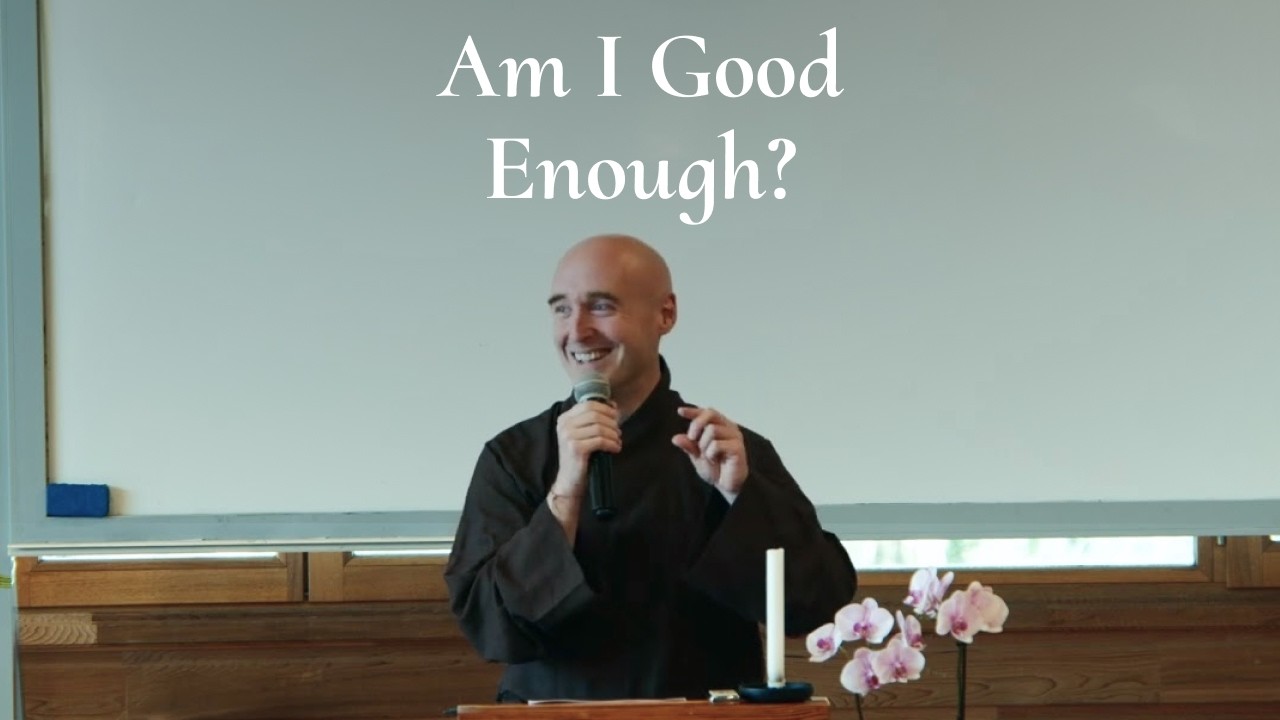
In this guided meditation and contemplation session, Brother Phap Huu from Plum Village teaches that resilience and meaningful action in times of global suffering do not come from reacting with anger or hatred, but from grounding ourselves in mindful presence, connecting with our own hearts and aspirations, and accessing the collective wisdom of spiritual traditions. Through breath awareness, body scanning, and a specific contemplative practice, practitioners learn to become "lucid and calm" so they know exactly what actions to take—and what not to do—to avoid multiplying harm in the world.
How does breath awareness become a foundation for resilience?
Brother Phap Huu begins the session by inviting participants to find a comfortable posture and enter a state of meditation. The first step is simple but deliberate: paying attention to the natural rhythm of the breath (0:10–1:30). He instructs, "As you breathe in, just know that this is an inbreath. As you breathe out, know that this is an outbreath." This basic labeling—naming the breath without trying to change it—serves as an anchor for the mind and a way to arrive into the present moment together as a group.
The instruction to accept the breath as it is—whether long or short, deep or shallow—removes the effortfulness that often accompanies meditation practice. Rather than struggling to achieve a particular state, the practitioner simply witnesses what is already happening. This foundational gesture of acceptance becomes, paradoxically, the beginning of resilience. Brother Phap Huu teaches that arriving into the present moment, even when it contains discomfort, pain, or suffering, is an act of grounding. He says: "Even if there is discomfort, pain, suffering, the present moment is where I dwell" (4:27–5:06). This willingness to be fully present—not as passive resignation but as active choice—creates the stable ground from which meaningful action can arise.
What role does body awareness play in releasing tension?
After establishing breath awareness, Brother Phap Huu guides participants to scan the body and notice what sensations are present. "I invite us to also pay attention to any of the sensations that are coming up in our body. Just accepting the sensation and just naming it. If there is ease in the body, if there's tension, if there's restlessness, whatever it may be, just gently acknowledge, embrace it" (0:37–1:02).
This body scan is not about fixing or eliminating sensations but about meeting them with a quality of gentle recognition. The practice moves from noticing to action: "As I breathe in, I become aware of my whole body. As I breathe out, I relax my whole body" (2:24–2:31). By bringing conscious attention to the muscles and areas holding tension, the practitioner invites the body to release what it no longer needs. This is a key teaching: the body holds the impacts of fear, anger, and stress. Until the nervous system itself feels safe and held, the mind cannot fully access clarity and compassion. Brother Phap Huu's guided body relaxation addresses this embodied dimension of resilience.
How can practitioners remain calm when facing overwhelming global events?
The session takes a turn into explicit contemplation around the 5:46 mark when Brother Phap Huu offers a reflection on how practitioners can hold awareness of global suffering without being consumed by it. He acknowledges: "Breathing, we are mindful that the unfolding events of the world may be overwhelming for many of us. We are aware that there is tremendous amount of suffering, fear, anger, and hatred going on" (5:54–6:23).
Rather than denying this reality, the teaching directly addresses the emotional and psychological terrain. But the response is not to match anger with anger. Brother Phap Huu articulates a core principle: "But we know deep in our hearts that we cannot respond to anger and hatred with anger and hatred. This will only cause anger and hatred to multiply a thousandfold" (6:33–6:45). This is not a naive or passive stance; it is a clear-eyed recognition that the structure of anger and hatred is self-perpetuating. To break the cycle, the practitioner must access a different register of consciousness—one grounded in clarity and compassion.
To support this shift, Brother Phap Huu invokes the presence of spiritual teachers across generations: "In this very moment, we invoke all of our spiritual teachers over many generations, Buddhas and bodhisattvas to be with us, helping us to embrace the suffering of our shared humanity and to hold each other with care" (6:50–7:07). This invocation serves several functions: it situates the individual practitioner within a lineage of wisdom, it reminds the community that they are not alone, and it calls forth the resources of compassion that already exist within the spiritual tradition.
What does it mean to become "lucid and calm" in response to injustice?
A crucial moment in the contemplation comes when Brother Phap Huu teaches what lucidity and calm actually enable: "May we become lucid and calm so that we know exactly what to do and what not to do to make the situation worse" (7:12–7:18). Lucidity here means clear seeing—the ability to perceive a situation without the distortion of reactivity. Calm does not mean indifference; it means the nervous system is regulated enough to think and act strategically. From this state, the practitioner can distinguish between actions that contribute to transformation and those that inadvertently feed the cycle of harm.
Brother Phap Huu explicitly affirms those working for justice: "We know that there are those of us who are working towards the healing and transformation of the injustice in this world and we are grateful to them" (7:24–7:29). This is crucial: the teaching does not retreat from engagement with injustice. Rather, it insists that effective action on behalf of justice requires the stability and clarity that come from spiritual practice. The implication is that mindful resistance—action taken from a place of composure and wisdom rather than reaction—is more effective and more sustainable than action driven by rage.
How does compassion break the cycle of violence?
The contemplation circles back to the question of response: "We know that responding to hatred and violence with wisdom and compassion is the only path forward. May our collective practice disrupt the cycles of violence within us and beyond" (7:50–8:00). Brother Phap Huu teaches that violence has an inner dimension—the cycles of reactivity, resentment, and hatred that live inside us—and an outer dimension. Contemplative practice directly addresses the inner cycles, which is why collective practice can have a disruptive effect on the outer patterns.
The emphasis on tenderness is notable: "At this moment there are those who are experiencing deep suffering and pain. Let us be there for them and embrace them tenderly with our awareness, compassion and understanding" (7:35–7:46). Tenderness here is not weakness; it is the capacity to be fully present to suffering without becoming overwhelmed by it or pulling away in protection. This quality of presence itself is healing and becomes a form of resistance to the numbness and disconnection that violence often produces.
What are the fruits of collective practice?
Near the midpoint of the contemplation, Brother Phap Huu names the gifts that a community of practitioners can offer: "In this moment, let us please offer humanity the best fruits and flowers of our practice: clarity, solidity, togetherness, understanding and compassion" (5:56–6:10). These five qualities—clarity, solidity, togetherness, understanding, and compassion—are not abstract ideals but concrete fruits that emerge when a group of people ground themselves in mindfulness and intention together.
Clarity allows us to see situations as they are. Solidity means we do not collapse under pressure but remain stable. Togetherness reminds us that we do not face these challenges alone. Understanding opens us to the roots and conditions that give rise to suffering. Compassion is the readiness to ease that suffering. When a community cultivates these qualities together through meditation and contemplation, they become a resource available to humanity at large. This is the teaching of interdependence: our individual practice contributes to the collective field.
Where to go from here?
This session is an entry point into the broader offerings of Plum Village, the international Zen Buddhist community founded by Thich Nhat Hanh. For those drawn to deepening this work, the organization offers an online course, "Zen and the Art of Saving the Planet" (ZASP), which brings together 20+ monastic and lay dharma teachers to explore how spiritual practice and environmental action are inseparable. The guided meditation and contemplation offered by Brother Phap Huu in this video provides a concrete practice you can return to daily—one that both stabilizes your own nervous system and contributes to the healing of collective consciousness. The invitation is to recognize that in moments of global crisis and personal overwhelm, the steadiest response is not to burn brighter with rage, but to return again and again to the breath, to the body, to the present moment, and to the deep wells of compassion within yourself and within the community.