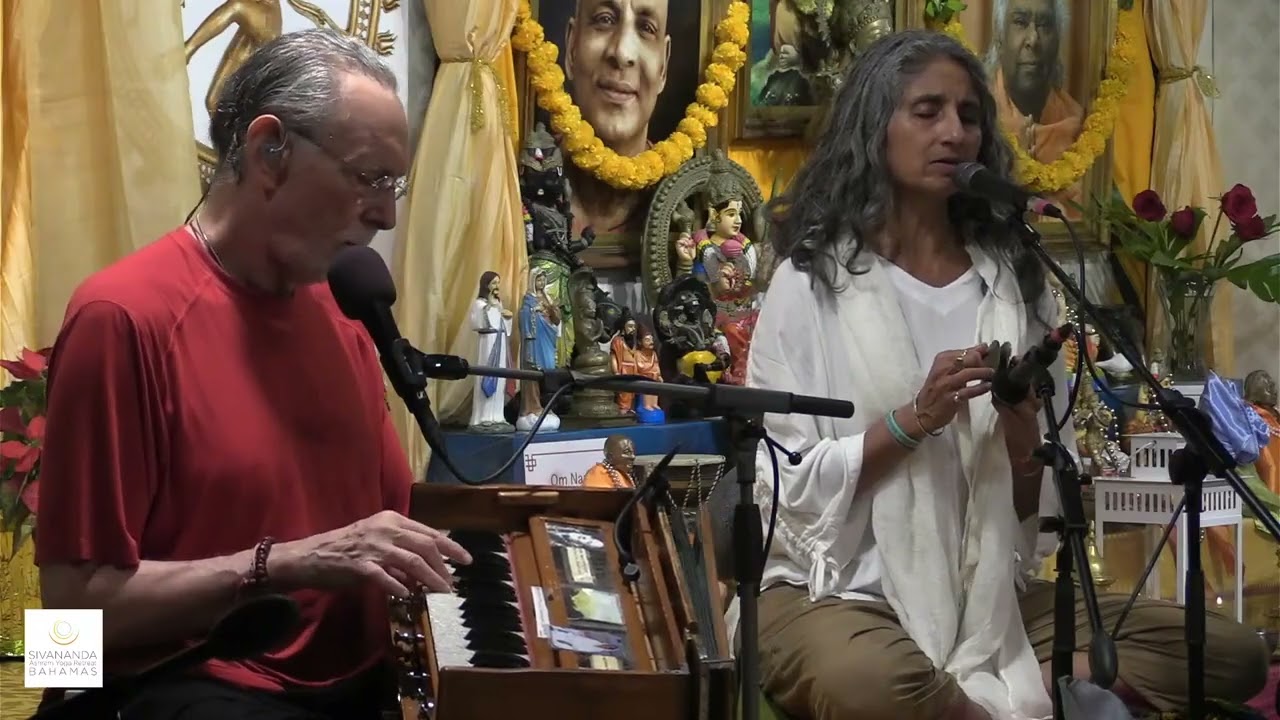
This two-hour Thursday Night Satsang kirtan session features Krishna Das, a renowned bhakti yoga teacher and kirtan wallah (chanting leader), guiding devotees through call-and-response chanting of sacred Sanskrit names and mantras. Kirtan is a nondual practice rooted in the Bhagavad Gita and Hindu devotional traditions that uses the repetition of divine names—particularly Krishna and Rama—to dissolve the ego-mind and access the heart's innate wisdom. The session combines traditional kirtan melodies with contemporary accessibility, creating a container for collective spiritual awakening and direct experience of what Krishna Das calls "the heart of all existence."
What Is Kirtan and Why Does Krishna Das Practice It?
Kirtan is a form of call-and-response chanting, most commonly associated with bhakti yoga and Hindu devotional traditions. In a kirtan session, a leader chants a mantra or divine name, and the group responds, repeating the words in unison. The practice is rooted in ancient Vedic and tantric texts and is fundamentally about devotion—bhakti—as a direct path to liberation and union with the divine.
Krishna Das has spent decades refining and sharing this practice with Western audiences. His approach honors the traditional roots of kirtan while making it accessible to contemporary practitioners from all faith backgrounds. Rather than requiring prior knowledge of Sanskrit or Hindu theology, kirtan invites participants to engage directly through sound and repetition. The chanting itself becomes a meditation, a prayer, and a technology for opening what Krishna Das often refers to as the "heart space"—the center of compassion, presence, and non-dual awareness that lies beneath the thinking mind.
How Does Chanting Work as a Spiritual Practice?
The mechanism of kirtan operates on several levels simultaneously. On the surface, repetitive chanting of a mantra—such as "Hare Krishna, Hare Krishna, Krishna Krishna, Hare Hare"—creates a rhythm that naturally settles the mind. The breath synchronizes with the chant, the body enters a state of relaxed attentiveness, and the constant stream of thoughts begins to quiet. This alone produces measurable physiological benefits: reduced cortisol, lowered heart rate, and activation of the parasympathetic nervous system.
But kirtan is not merely meditation with sound. In the devotional framework that Krishna Das teaches, the mantra is understood to be a direct invocation of the divine reality. The names themselves—Krishna, Rama, Devi, Shiva—are not separate from what they represent; they are vehicles for recognizing one's own true nature. As one chants, the boundary between the chanter and the chanted gradually dissolves. The individual ego, which typically insists on its separateness, becomes less compelling. What remains is a sense of belonging, of being held within something infinitely larger and more fundamental than the personal self.
Krishna Das emphasizes that this is not blind faith or belief. It is direct experience accessible through sustained practice. The heart, when touched by sincere repetition of these names, begins to recognize itself in what is being invoked. This is why kirtan is sometimes called "the yoga of the heart"—it bypasses intellectual argument and works directly through feeling, resonance, and vibration.
What Makes Thursday Night Satsang Different From Other Kirtan Events?
Satsang literally means "gathering in truth." A Thursday Night Satsang, particularly one conducted at a retreat center like Menla Mountain Retreat in Phoenicia, New York, combines kirtan with the community container of collective practice. The energy that arises when multiple people chant together is qualitatively different from solitary chanting. There is a synergy—a mutual reinforcement of intention and opening.
In the format Krishna Das typically uses, the session may begin with an invocation or brief teaching, followed by extended periods of kirtan in different melodies and rhythms. The leader watches the group's energy, adjusting the pace and duration of each chant to deepen the collective experience. Some chants are rapid and ecstatic, building energy; others are slow and plaintive, drawing practitioners inward. The skilled kirtan wallah—and Krishna Das is widely recognized as one of the finest—reads the room and guides people through natural waves of opening.
A Thursday evening satsang also often includes moments of silence or teaching between chants, allowing space for integration and reflection. This prevents the experience from becoming entertainment or passive consumption. Participants are invited to bring their own voice, their own heart, into the practice rather than simply listening.
How Does Krishna Das Approach Teaching Kirtan to Western Audiences?
Krishna Das is American, born Jeffrey Kagel, and has lived in India, studied with various gurus, and brought Vedic kirtan into mainstream Western consciousness over several decades. His approach is distinctive because he does not require conversion to Hinduism or acceptance of any particular theology. Instead, he emphasizes the universality of the heart's capacity for devotion and the power of sound itself.
In his teachings and musical arrangements, Krishna Das often uses simple, repetitive melodies that are easy to learn and remember. He also frequently incorporates bhajans—devotional songs—that carry both traditional Hindu content and contemporary relevance. His musical arrangements blend the acoustic simplicity of traditional kirtan with subtle production values that help the practice feel both timeless and accessible.
Krishna Das also teaches that kirtan is not about perfection or performance. There is no "right" way to chant. Whether a voice is beautiful or rough, confident or hesitant, the only requirement is sincerity—the willingness to show up and let the mantra do its work. This democratizes the practice and removes a common barrier: the shame or self-consciousness that prevents people from joining in.
What Is the Role of the Heart in Krishna Das's Teaching?
Central to Krishna Das's approach is the distinction between heart and mind. The mind is the seat of conceptual thinking, judgment, comparison, and the constructed sense of self. The heart is where wisdom, compassion, intuition, and authentic presence reside. Much of modern spiritual seeking, Krishna Das suggests, remains stuck in the mind—trying to think one's way to enlightenment. Kirtan, by contrast, is a method for shifting awareness from the mind into the heart.
When people chant together, the activity bypasses the critical mind. You cannot simultaneously judge yourself and fully sing "Hare Krishna." The chant itself becomes an anchor that pulls awareness away from self-reference and into present-moment connection with others and with the mantra itself. Over time, this reorientation creates lasting shifts in how one moves through life. Practitioners report greater access to compassion, less reactivity, more patience, and a felt sense of belonging even in difficult circumstances.
Who Benefits From Kirtan Practice?
Kirtan is accessible to people with no prior spiritual experience. You do not need to be a musician, to believe in God, or to understand Sanskrit. The practice works across age groups and physical abilities, though the core experience is the same: the opportunity to move from isolation into connection, from mental loops into heart presence, from the illusion of separation into a direct sense of belonging.
People are drawn to kirtan for many reasons. Some come for stress relief and the neurobiological benefits of rhythmic chanting. Others come seeking a spiritual community or a container for grief. Some are exploring Hindu or Vedic traditions. Others are simply moved by the music and the collective energy. All of these reasons are valid, and the practice meets people where they are.
Krishna Das often notes that the most profound openings sometimes occur not in people seeking dramatic spiritual experiences, but in those who come simply to be present and sing. There is a kind of grace in the practice itself—an intelligence built into the mantra and the form—that works independently of the practitioner's expectations or beliefs.
Where to Go From Here
If you are interested in exploring kirtan or continuing your practice, Krishna Das maintains an extensive online presence and community. His website at krishnadas.com lists upcoming events, including Thursday Night Satsangs and extended retreats. The Heart Space Digital Library, managed through the Kirtan Wallah Foundation, offers recorded kirtans, webinars, and workshops accessible through a free personal account.
For those new to kirtan, starting with a recorded session or a live event in your area is the most direct entry point. There is no need to prepare; simply show up and let yourself participate as feels natural. If you prefer to deepen your understanding first, Krishna Das maintains an extensive reading list at krishnadas.com, which includes both traditional Vedic texts and contemporary dharma teachings that illuminate the philosophical foundations of kirtan practice.